a personal journal on my universe surfing through the multiverse
Author: J. Sands Loch
Student and teacher of reality in all its forms.
I self-published my personal experience of discovering and trying to understand and use a model of reality based on the Many Worlds Interpretation of Quantum Mechanics:
Surfing the Multiverse: Finding Happiness One Universe at a Time
Available on Kindle and from Amazon, and found in blog post form at:
SurfingTheUniverse.com
The first crescent moon of 2025 was visible in early January, with the moon being 3.6% illuminated on January 1st. The next crescent moon of 2025 will be particularly scenic. It will be 6% illuminated and visible an hour after sunset. For the last seven days, all planets except Mercury have been visible in a “planetary parade”.
Today, let’s explore the power of compounding—the phenomenon that Albert Einstein reportedly called the eighth wonder of the world—through a simple mathematical lens: three to the third power (3³). This humble equation holds an enlightening lesson for investors seeking long-term growth.
The Power of 3³ and Synchronicity
3³ equals 27. While it’s a basic calculation, it symbolizes a profound concept: small increments of growth can generate exponential results over time. In investment terms, compounding works similarly by reinvesting returns to grow not just your initial principal but also the returns on those returns.
I’d like to introduce the Rule of 123. Four days ago I blogged about the synchronicity that 123 has for me, and now with this blog post it is even more synchronistic to me.
To further appreciate compounding’s power, consider the Rule of 123: a simple way to estimate how long it takes for an investment (or debt) to triple. Divide 123 by your annual rate of return. For example:
• At a 12.3% return, your money triples in approximately 10 years (123 ÷ 12.3 = 10).
• At a 24.6% return, it triples in about 5 years (123 ÷ 24.6 = 5).
Now, imagine you owe $1,000 on a credit card with a 24.6% interest rate. If unpaid, the balance triples in 5 years due to compounding. After another 5 years, it triples again, and by 15 years, it has tripled three times, growing to an overwhelming $27,000.
Paying off this original $1,000 debt is equivalent to earning a guaranteed 24.6% annual return on an investment—a return that’s nearly impossible to find in the stock market. This underscores the importance of eliminating high-interest debt as a financial priority.
Three Strategies to Maximize Compounding
Start Early Time is the most critical variable. Even small contributions made in your 20s can surpass larger investments made later in life. For example, investing $200 monthly starting at age 25, with an average 8% return, grows to nearly $700,000 by age 65. Starting at 35, the same $200 monthly only reaches about $300,000.
Stay Consistent Volatility is inevitable, but regular contributions during market dips can significantly enhance long-term returns. Dollar-cost averaging—investing a fixed amount at regular intervals—helps reduce the impact of market timing.
Reinvest Dividends Dividends may seem small initially, but when reinvested, they turbocharge compounding. Over decades, they can account for a significant portion of total returns, especially in high-dividend-paying stocks.
The Caveat: Compounding Cuts Both Ways
Compounding isn’t exclusive to growth; it also magnifies debt and fees. Credit card interest, for instance, compounds in the lender’s favor, turning small balances into unmanageable debts. Similarly, excessive fees on investment accounts can erode long-term gains. A 2% annual fee may sound trivial, but over 30 years, it can slash your returns by up to 40%.
Conclusion: Think in Exponents, Not Additions
Investment compounding is about shifting your mindset from linear growth to exponential growth. It rewards discipline, patience, and long-term thinking. By optimizing the three factors—principal, rate of return, and time—you can harness the magic of 3³ and turn modest investments into life-changing wealth.
So, as you review your financial goals this year, remember the lesson of 3³: small, consistent actions grow into extraordinary outcomes over time. Embrace compounding, and let time work its wonders.
Happy investing!
Update 2025-0127M-1545 Radio East
The stock market just closed and just as it was five years ago, it was a large down day in the market. Five years ago, I posted:
Unlike five years ago, today’s market drop was more technology company centric – especially influenced by an oversized drop in Nvidia. The S&P 500 dropped one and a half percent to around 6000, DOW actually gained two-thirds of a percent to around 44,700, and Nasdaq dropped a little over three percent to around 19,320. My own portfolio was up big with $APPL and $EB, and down big with $AMD.
Many people equate intimacy with sexual intimacy. When someone asks “Are you two intimate?”, the implication is sexual intimacy. But what about all of the other ways that two people can be intimate? I believe that thinking of intimacy in the broader sense can be useful in helping people form intimate connections with others. It can also be useful in measuring one’s intimacy with someone. If you do this with multiple people, you can perhaps find patterns in which you are resistant to a particular type of intimacy. You can also find types of intimacy that come more easily for you.
1. Emotional Intimacy – Feeling safe and free to express authentically. Includes witnessing and being present with each other’s emotions, vulnerabilities, triggers, and traumas.
2. Communication Intimacy – Trusting each other to share personal details, engage in meaningful conversations, and create a space of openness and understanding.
3. Physical Intimacy – Non-sexual physical touch, such as hugging, holding hands, cuddling, and other forms of platonic closeness.
4. Sensual Intimacy – Sensory connection through touch, smell, taste, and sound. Includes stroking, massaging, or exploring someone’s body through the senses.
5. Kinetic Intimacy – Movement-based connection, such as dancing, acrobatics, physical activities, or how you move and flow together in space.
6. Sexual Intimacy – Exchanging sexual energy and sexual touch, including vulnerability in sexual expression and willingness to explore your sexuality with each other.
7. Experiential Intimacy – Sharing time, interests, activities, and passions. Includes shared adventures, hobbies, and group/tribal experiences.
8. Intellectual Intimacy – Engaging in stimulating conversations, exploring ideas, and understanding how each other’s minds work. Includes shared curiosity and appreciation for intellect.
9. Knowing Intimacy – Deep understanding of each other’s likes, dislikes, values, histories, and personal nuances. Includes knowing someone’s preferences, memories, and life story.
10. Drugs/Alcohol Intimacy – Awareness of how substances affect each other, shared experiences involving substances, and understanding historical or current use, including addictions.
11. Energetic Intimacy – How it feels to be in each other’s presence. A willingness to be impacted by their energy, aura, or emotional states.
12. Cohabitation Intimacy – Comfort and willingness to be fully exposed as a human. Includes aspects such as nudity, bodily functions, and sharing a common home.
13. Temporal Intimacy – Understanding and witnessing someone’s cycles, changes, and routines over time. Includes knowing how they are during different times of day, seasons, or life phases.
14. Sleep Intimacy – Sharing the experience of sleep, including habits, preferences, and rhythms such as snoring, talking during sleep, or waking routines.
15. Creative Intimacy – Collaborating on creative projects, artistic endeavors, or shared expression through imagination and creation.
16. Humor Intimacy – Sharing laughter, inside jokes, and understanding each other’s sense of humor as a bonding experience.
17. Cultural Intimacy – Sharing and respecting each other’s cultural backgrounds, traditions, and experiences.
18. Financial Intimacy – Transparency, collaboration, and understanding regarding finances, money management, and shared goals.
19. Spiritual Intimacy – Exploring and sharing beliefs, practices, and spiritual growth. Includes witnessing someone’s spiritual journey and holding space for sacredness.
From a universe surfing point of view, each of these types of intimacies have an attractive force on the other types of intimacies. So, increasing one form of intimacy with someone brings you closer to a universe in which another form of intimacy is increased. If you and someone else are interested in tandem universe surfing to increased intimacy, pick one of these types that most resonates with both of you and dive in!
If you like this post, you might also like one of the most viewed post I have written.
The last two days I have been posting images from my journal written eight years ago. The journal pages are the beginning of a second book on universe surfing that I started writing then.
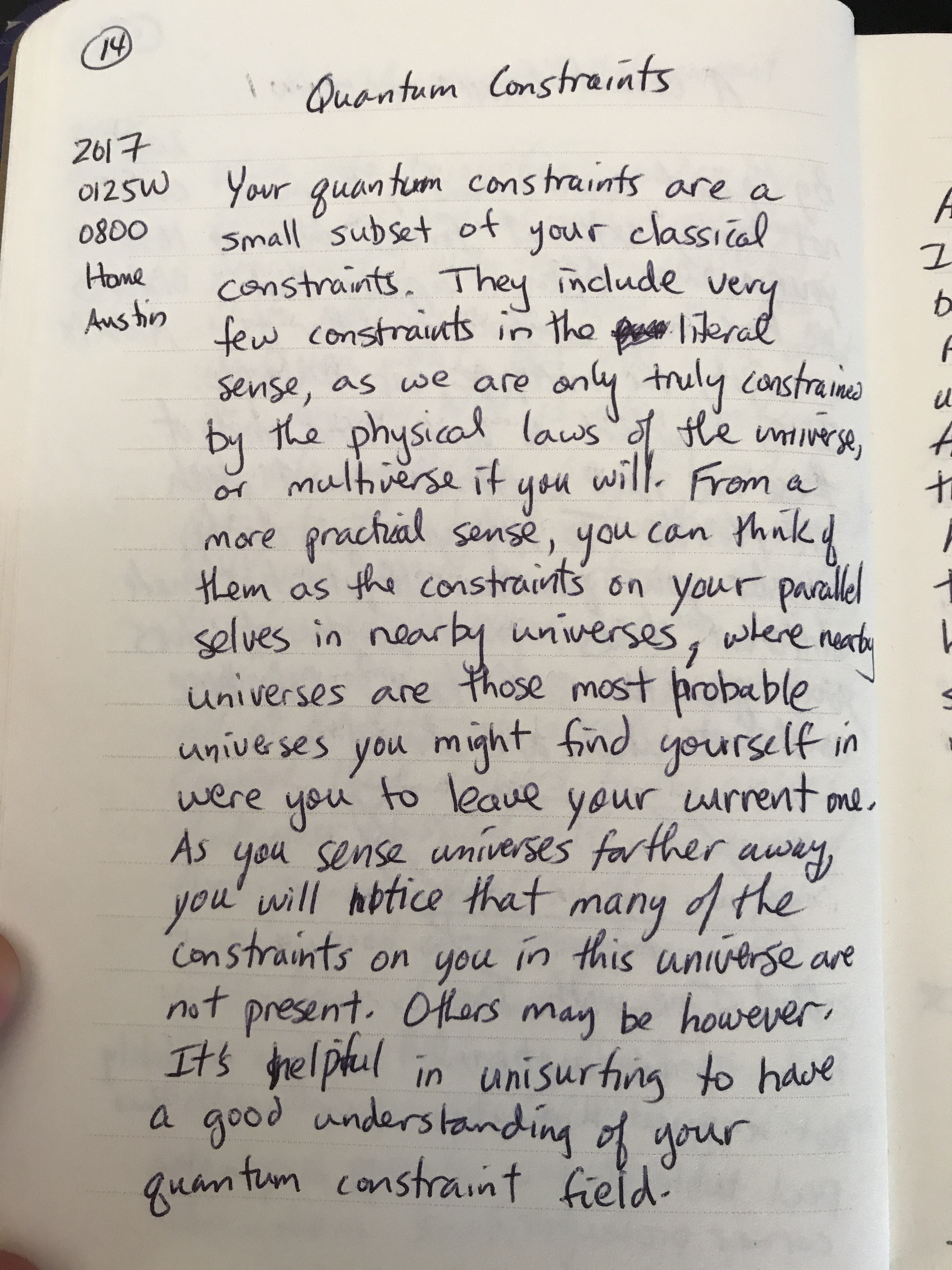
Your quantum constraints are a small subset of your classical constraints. They include very few constraints in the literal sense, as we are only truly constrained by the physical laws of the universe, or multiverse if you will. From a more practical sense, you can think of them as the constraints on your parallel selves in nearby universes, were nearby universes are the most probable universes you might find yourself in were you to leave your current one. As you sense universes farther away, you will notice that many of the constraints on you in this universe are not present. Others may be however. It’s helpful in unisurfing to have a good understanding of your quantum constraint field.
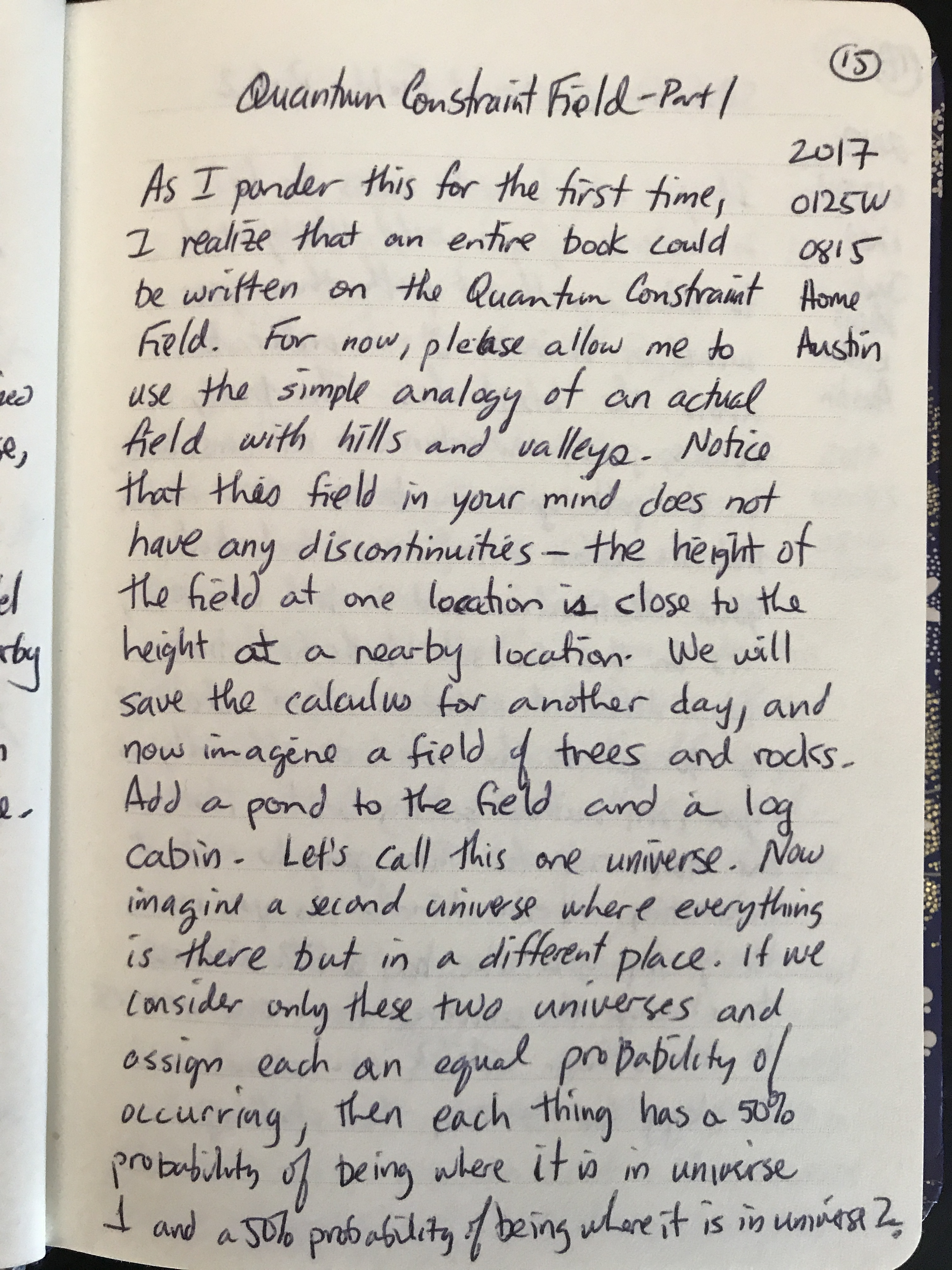
2017-0125W-0815 Home, Austin – Quantum Constraint Field – Part 1 (page 15)
As I ponder this for the first time, I realize that an entire book could be written on the Quantum Constraint Field. For now, please allow me to use the simple analogy of an actual field with hills and valleys. Notice that this field in your mind does not have any discontinuities – the height of the field at one location is close to the height at a nearby location. We will save the calculus for another data, and now imagine a field of trees and rocks. Add a pond in the field and a log cabin. Let’s call this one universe. Now imagine a second universe where everything is there but in a different place. If we consider only these two universes and assign each an equal probability of occurring, then each thing has a 50% probability of being where it is in universe 1 and a 50% probability of being where it is in universe 2.
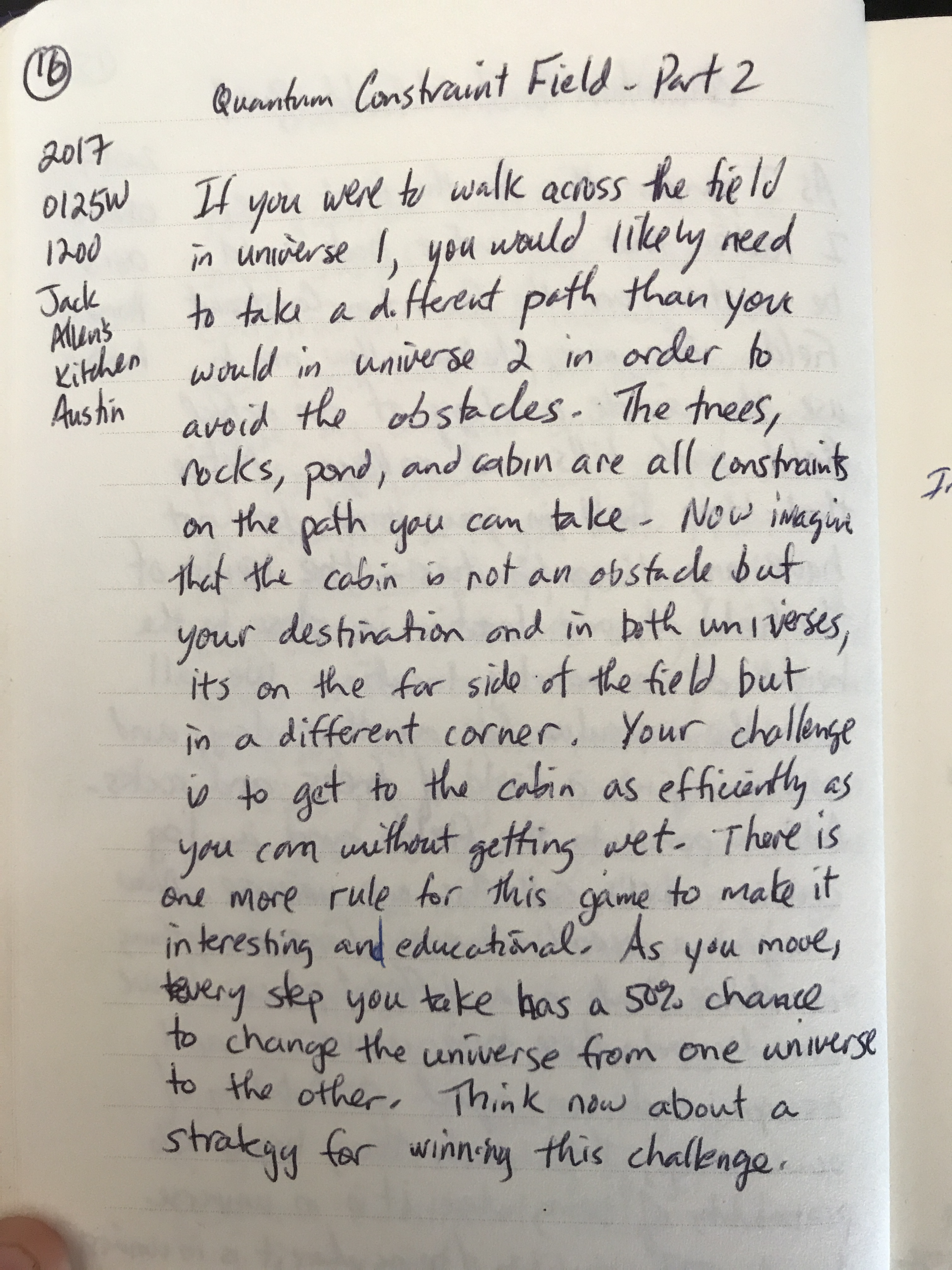
2017-0125W-1200 Jack Allen’s Kitchen, Austin, TX – Quantum Constraint Field – Part 2 (page 16)
If you were to walk across the field in universe 1, you would likely need to take a different path than you would in universe 2 in order to avoid the obstacles. The trees, rocks, pond, and cabin are all constraints on the path you can take. Now imagine that the cabin is not an obstacle but your destination and in both universes, it’s on the far side of the field but in a different corner. Your challenge is to get to the cabin as efficiently as you can without getting wet. There is one more rule for this game to make it interesting and educational. As you move, every step you take has a 50% chance to change the universe from one universe to the other. Think now about a strategy for winning this challenge.
I’m sitting in the sun with K as she get’s ready to host her cleanse. I just finished posting pictures from my journal from 8 years ago (2025 Day 23: One, Two, Three – Synchronicity). In this post, I am going to continue posting pictures from my journal from eight years ago today.
12 minutes ago, I was walking behind the back fence here at Radio East and I saw something shiny on the ground. It was a quarter, and then another quarter, and then a dime. Sixty! I quickly calculated. Wow!
K had just asked me about my birthday and what year I was born. I turn sixty this year! I’ve was already feeling the synchronicities around this number due to these past blog posts:
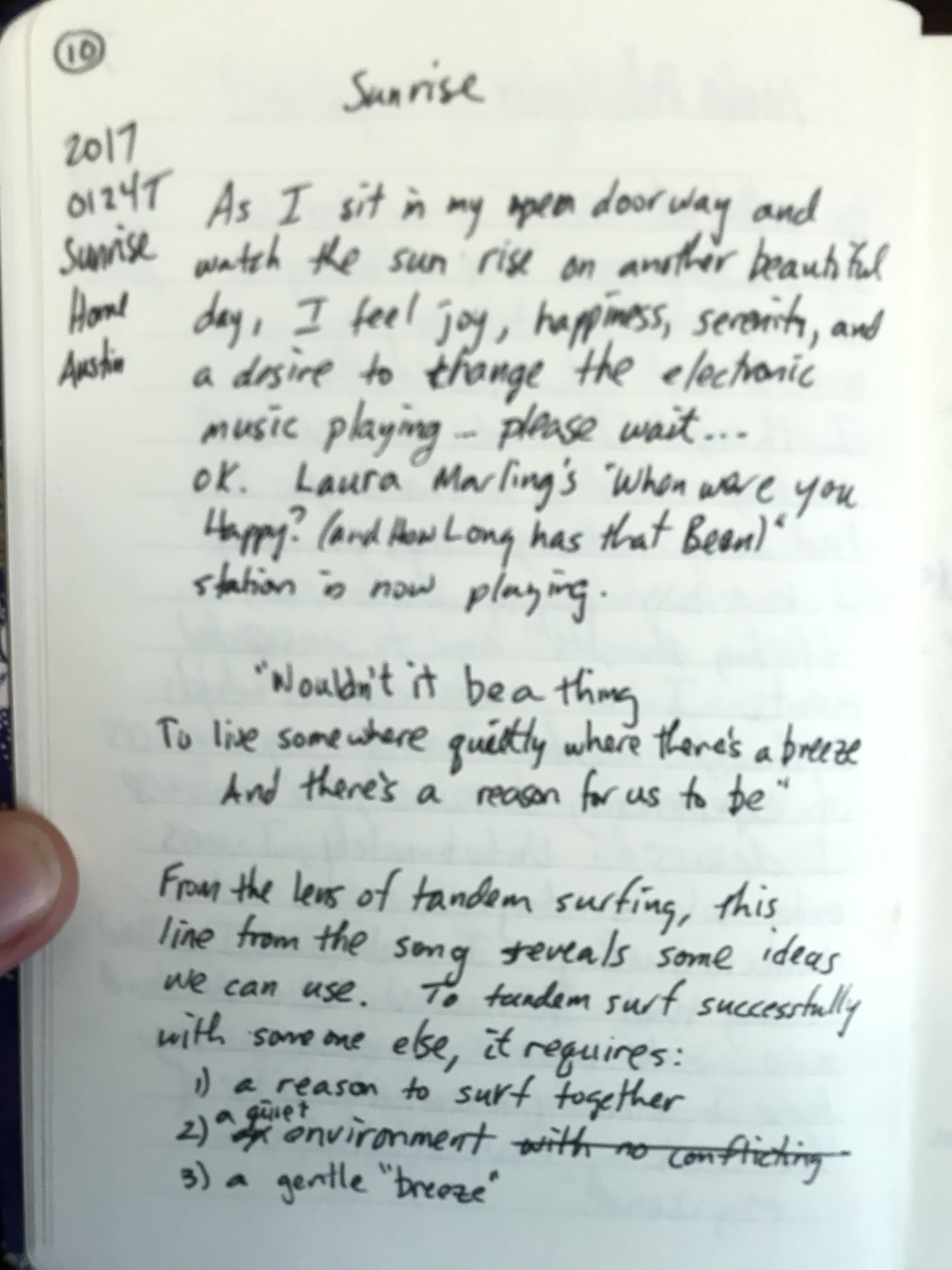
As I sit in my open doorway and watch the sun rise on another beautiful day, I feel joy, happiness, serenity, and a desire to change the electronic music playing … please wait … ok. Laura Marling’s “When were you Happy? (and How Long has that Been)” station is now playing.
"Wouldn't it be a thing
To live somewhere quietly where there's a breeze
And there's a moon for us to be"
From the lens of tandem surfing, this line from the song reveals some ideas we can use. To tandem surf successfully with someone else, it requires:
a reason to surf together
a quiet environment
a gentle “breeze”
2017-0124T-0800 Home, Austin – A Reason for us to Be (page 11)
To “be” means to enjoy the present moment, or to at least experience it – joy or sadness. Solo unisurfing is about being present in the moment, classically experiencing it, quantum experiencing, sensing the possibilities, knowing why certain future possibilities are important to you, knowing why the present moment is important to you, and making choices that guide you to the present moments you desire and that increase the probability of future possibilities you desire. Knowing why helps you sort through your desires. Likewise, for tandem unisurfing, knowing why for “us to be” and jointly knowing the future possibilities for “us” and why that union is desirable, along with making choices together, allowing for an enjoyable tandem unisurfing experience.
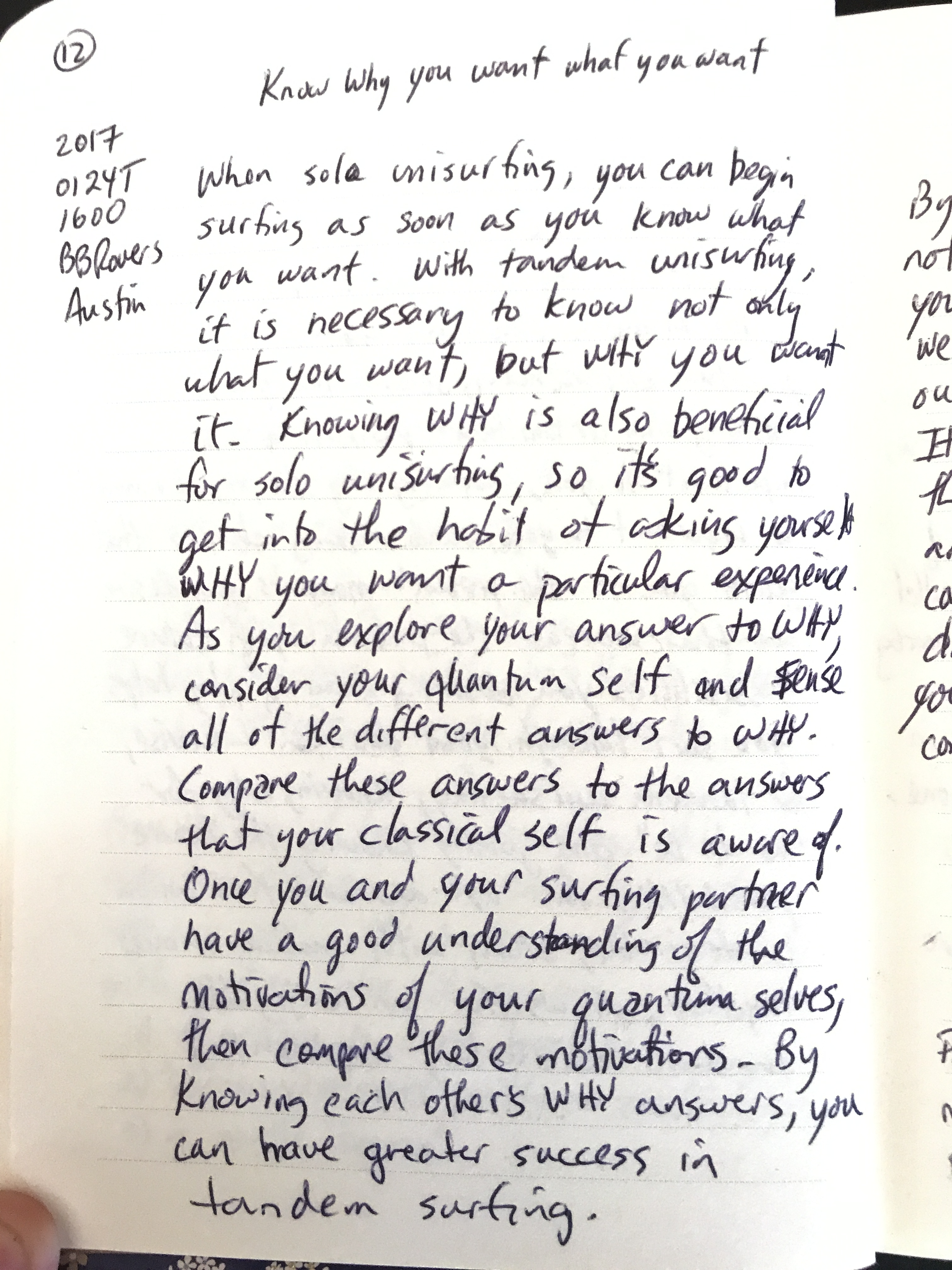
2017-0124T-1680 BBRovers, Austin – Know WHY you want what you want (page 12)
When solo unisurfing, you can begin surfing as soon as you know what you want. With tandem unisurfing, it is necessary to know not only what you want, but WHY you want it. Knowing WHY is also beneficial for solo unisurfing, so it’s good to get into the habit of asking yourself WHY you want a particular experience. As you explore your answer to WHY, consider your quantum self and sense all of the different answers to WHY. Compare these answers to the answers that your classical self is aware of. Once you and your surfing partner have a good understanding of the motivations of your quantum selves, then compare these motivations. By knowing each other’s WHY answers, you can have greater success in tandem surfing.
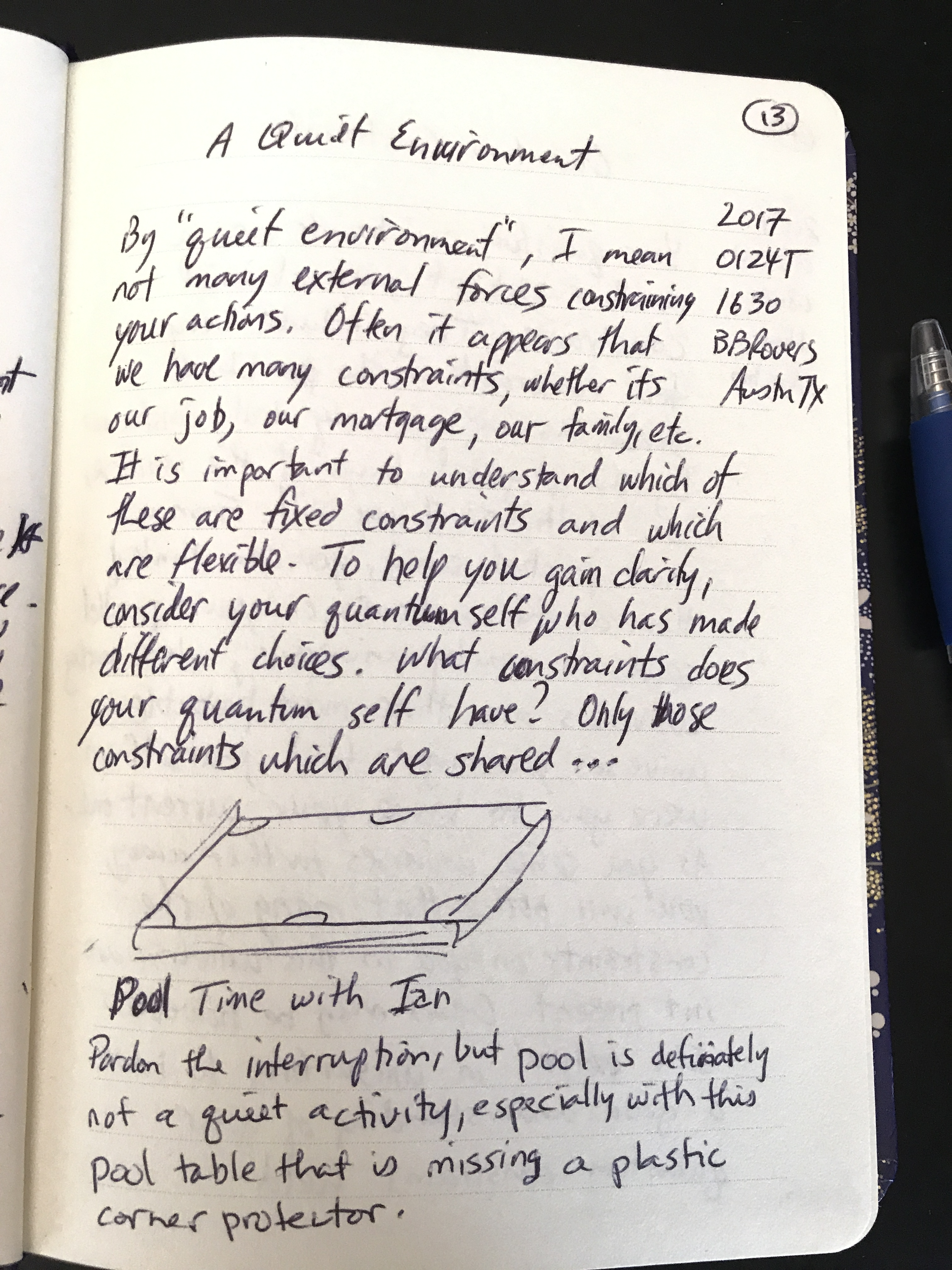
2017-0124T-1630 BBRovers, Austin, TX – A Quiet Environment (page 13)
By “quiet environment”, I mean not many external forces constraining your actions. Often it appears that we have many constraints, whether it’s our job, our mortgage, our family, etc. It is important to understand which of these are fixed constraints and which are flexible. To help you gain clarity, consider your quantum self, who has made different choices. What constraints does your quantum self have? Only those constraints where are shared …
Pool time with Ian
Parden the interruption, but pool is definitely not a quiet activity, especially with this pool table ihat is missing a plastic corner protector.




 surfing the universe