1/1/1 – Reducing 2026 to its vibrational essence, we get 1, so the theosophically reduced date is 1/1/1. The Pythmen would be happy that we keep the universe orderly today by honoring their ancient practice.
For the new year, the 3 downloads I received are truth, meaning, and harmony.
Truth – seek to know both your inner truth and the truth of your environment
Meaning – spend your precious energy in a way that is meaningful to you and your environment
Harmony – be in harmony with your truth, both internal and external
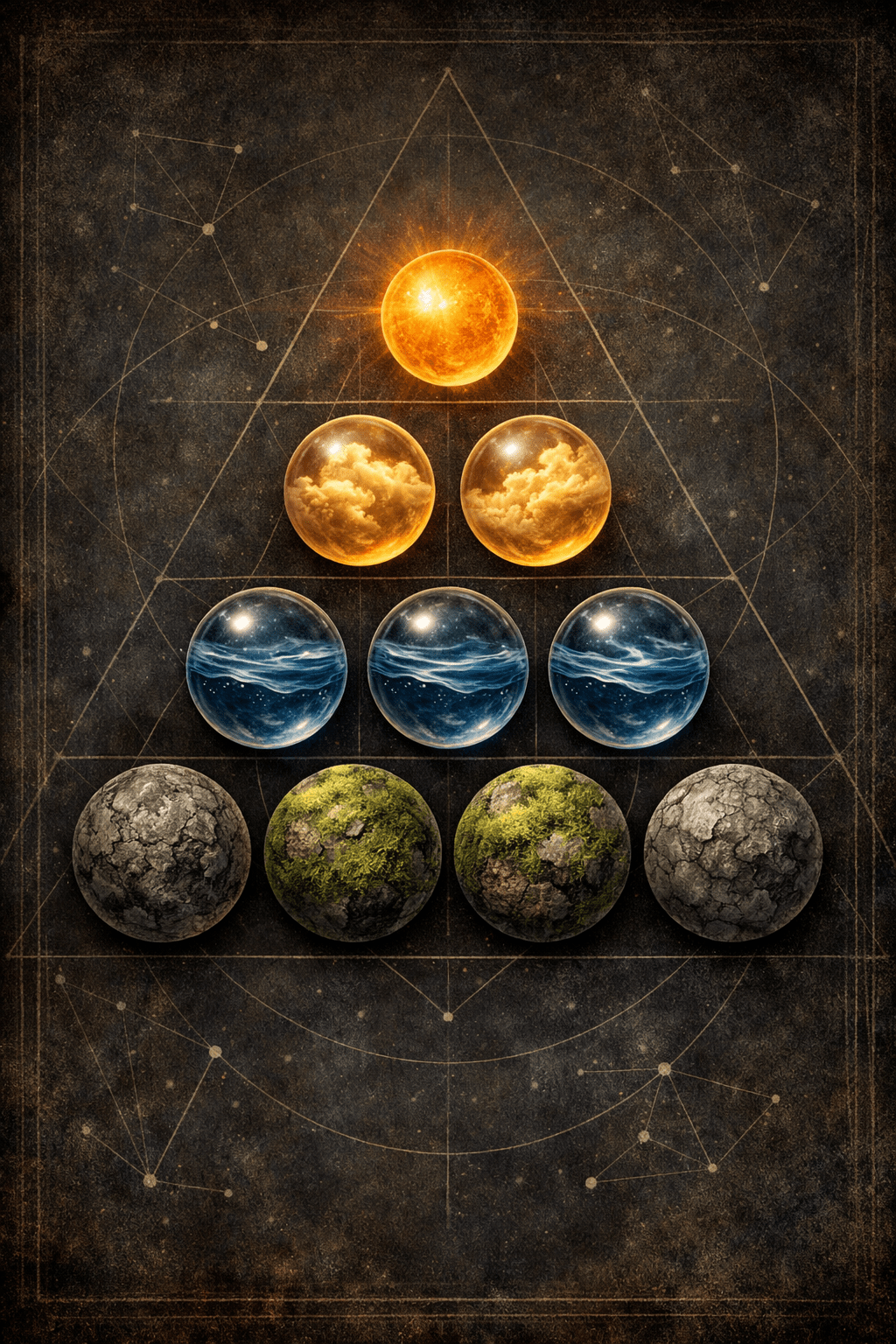
Fun fact: The Pythagoreans used the Tetracyts as a sacred symbol that represented the organization of the entire universe. The Tetracyts illustrated how the physical world is structured through geometry and dimensions:
One dot on first row represents the void, singularity, dimensionless
Two dots on second row represents a line, one dimension
Three dots on third row represents a surface/plane, two dimensions
Four dots on fourth row represents a solid, three dimensions
1+2+3+4=10, their perfect number that contained the essence of all things.
The four rows were also associated with the elements:
Fire – the creative spark and the most subtle form of matter
Air – the connective element that fills space between the sky/stars and the earth
Water – the flowing element that naturally spreads over a surface
Earth – the solid element that represents the completion of physical manifestation
Today, let’s explore the power of compounding—the phenomenon that Albert Einstein reportedly called the eighth wonder of the world—through a simple mathematical lens: three to the third power (3³). This humble equation holds an enlightening lesson for investors seeking long-term growth.
The Power of 3³ and Synchronicity
3³ equals 27. While it’s a basic calculation, it symbolizes a profound concept: small increments of growth can generate exponential results over time. In investment terms, compounding works similarly by reinvesting returns to grow not just your initial principal but also the returns on those returns.
I’d like to introduce the Rule of 123. Four days ago I blogged about the synchronicity that 123 has for me, and now with this blog post it is even more synchronistic to me.
To further appreciate compounding’s power, consider the Rule of 123: a simple way to estimate how long it takes for an investment (or debt) to triple. Divide 123 by your annual rate of return. For example:
• At a 12.3% return, your money triples in approximately 10 years (123 ÷ 12.3 = 10).
• At a 24.6% return, it triples in about 5 years (123 ÷ 24.6 = 5).
Now, imagine you owe $1,000 on a credit card with a 24.6% interest rate. If unpaid, the balance triples in 5 years due to compounding. After another 5 years, it triples again, and by 15 years, it has tripled three times, growing to an overwhelming $27,000.
Paying off this original $1,000 debt is equivalent to earning a guaranteed 24.6% annual return on an investment—a return that’s nearly impossible to find in the stock market. This underscores the importance of eliminating high-interest debt as a financial priority.
Three Strategies to Maximize Compounding
Start Early Time is the most critical variable. Even small contributions made in your 20s can surpass larger investments made later in life. For example, investing $200 monthly starting at age 25, with an average 8% return, grows to nearly $700,000 by age 65. Starting at 35, the same $200 monthly only reaches about $300,000.
Stay Consistent Volatility is inevitable, but regular contributions during market dips can significantly enhance long-term returns. Dollar-cost averaging—investing a fixed amount at regular intervals—helps reduce the impact of market timing.
Reinvest Dividends Dividends may seem small initially, but when reinvested, they turbocharge compounding. Over decades, they can account for a significant portion of total returns, especially in high-dividend-paying stocks.
The Caveat: Compounding Cuts Both Ways
Compounding isn’t exclusive to growth; it also magnifies debt and fees. Credit card interest, for instance, compounds in the lender’s favor, turning small balances into unmanageable debts. Similarly, excessive fees on investment accounts can erode long-term gains. A 2% annual fee may sound trivial, but over 30 years, it can slash your returns by up to 40%.
Conclusion: Think in Exponents, Not Additions
Investment compounding is about shifting your mindset from linear growth to exponential growth. It rewards discipline, patience, and long-term thinking. By optimizing the three factors—principal, rate of return, and time—you can harness the magic of 3³ and turn modest investments into life-changing wealth.
So, as you review your financial goals this year, remember the lesson of 3³: small, consistent actions grow into extraordinary outcomes over time. Embrace compounding, and let time work its wonders.
Happy investing!
Update 2025-0127M-1545 Radio East
The stock market just closed and just as it was five years ago, it was a large down day in the market. Five years ago, I posted:
Unlike five years ago, today’s market drop was more technology company centric – especially influenced by an oversized drop in Nvidia. The S&P 500 dropped one and a half percent to around 6000, DOW actually gained two-thirds of a percent to around 44,700, and Nasdaq dropped a little over three percent to around 19,320. My own portfolio was up big with $APPL and $EB, and down big with $AMD.
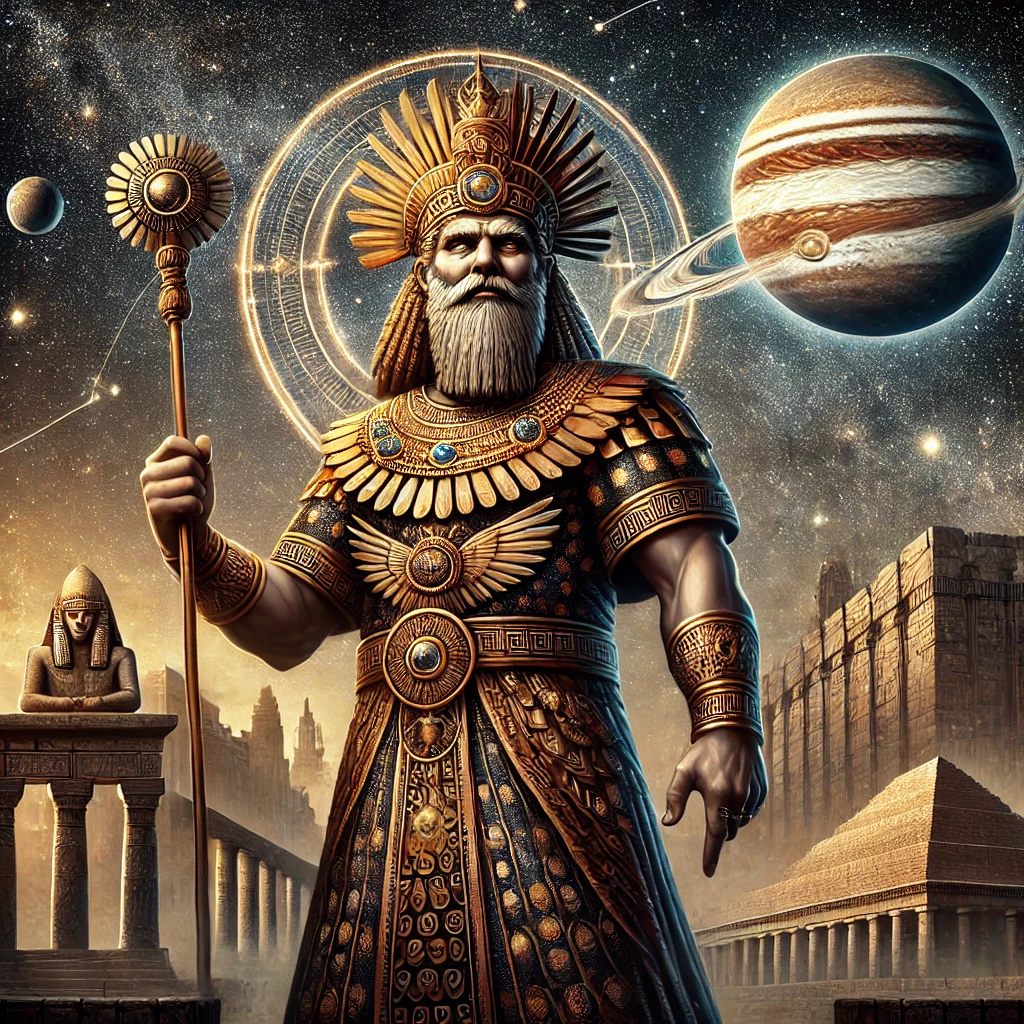
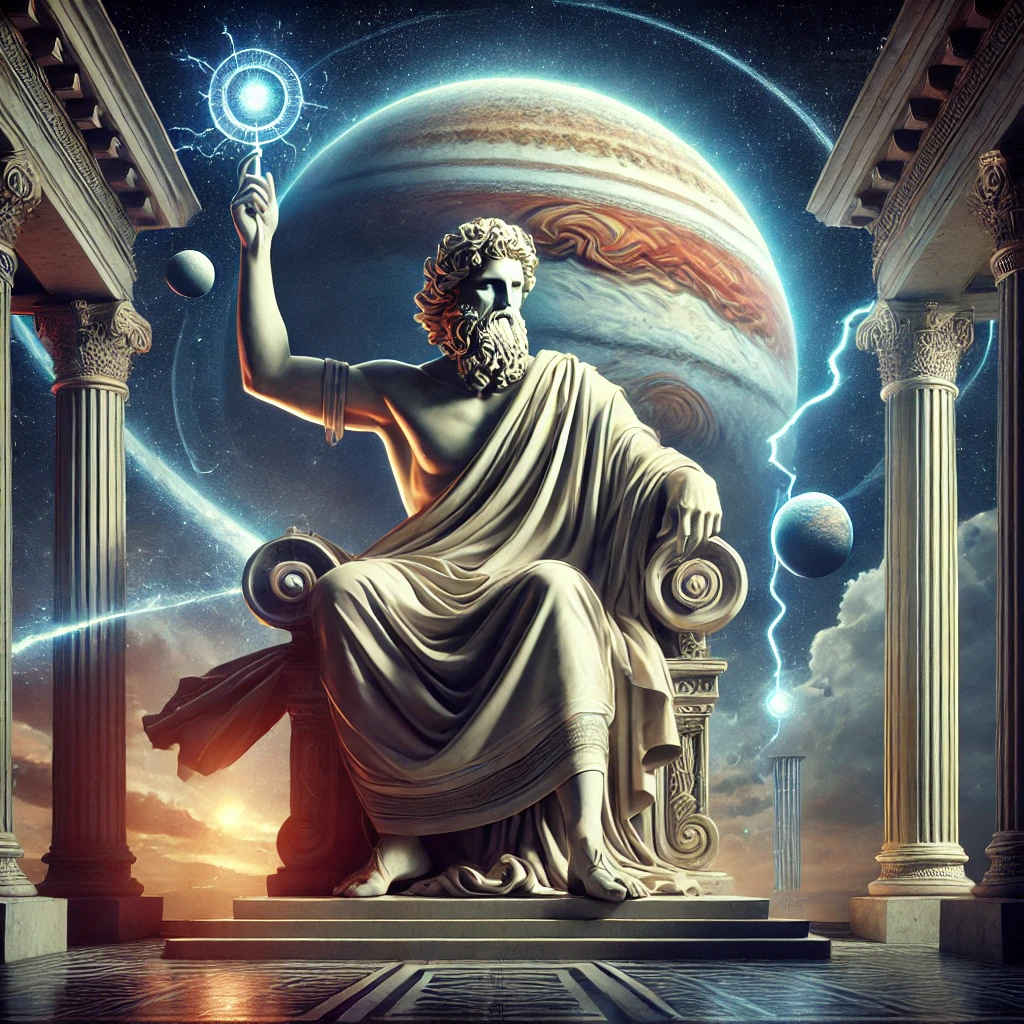
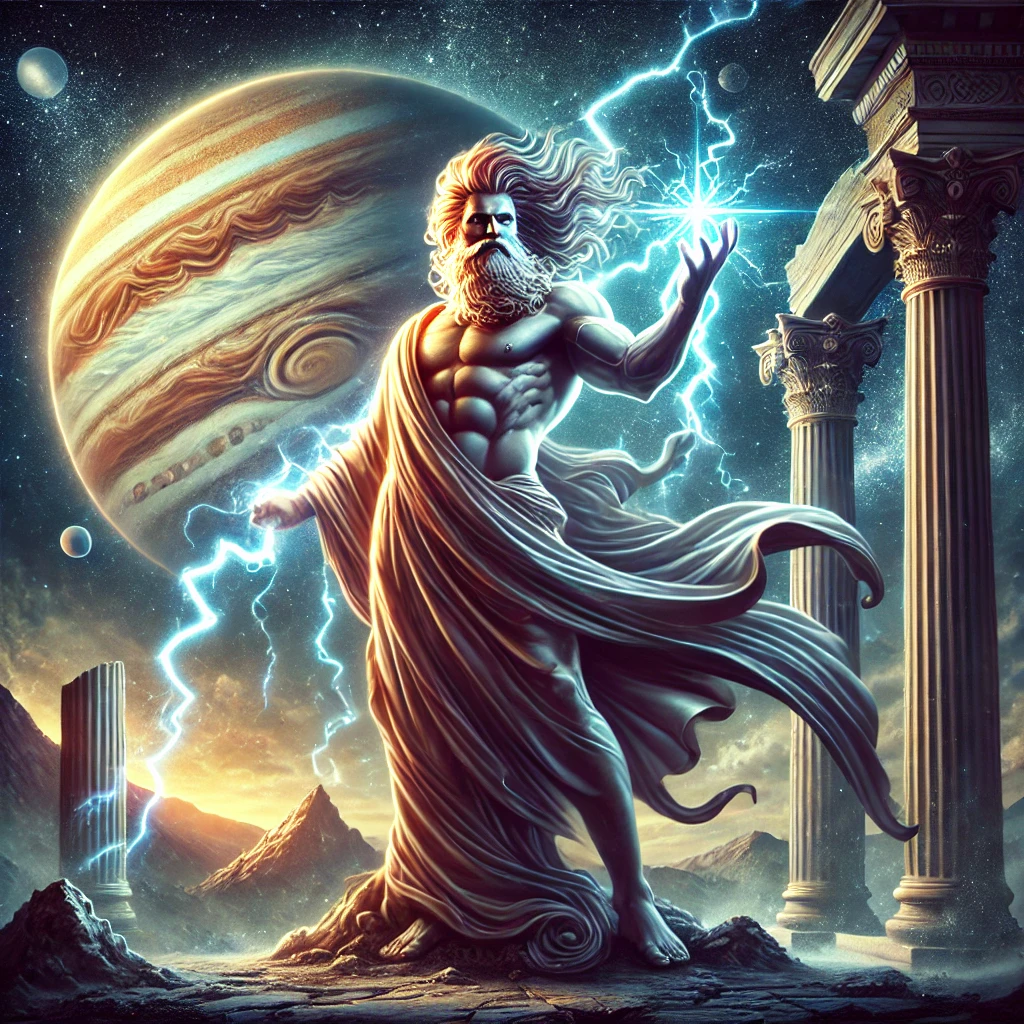
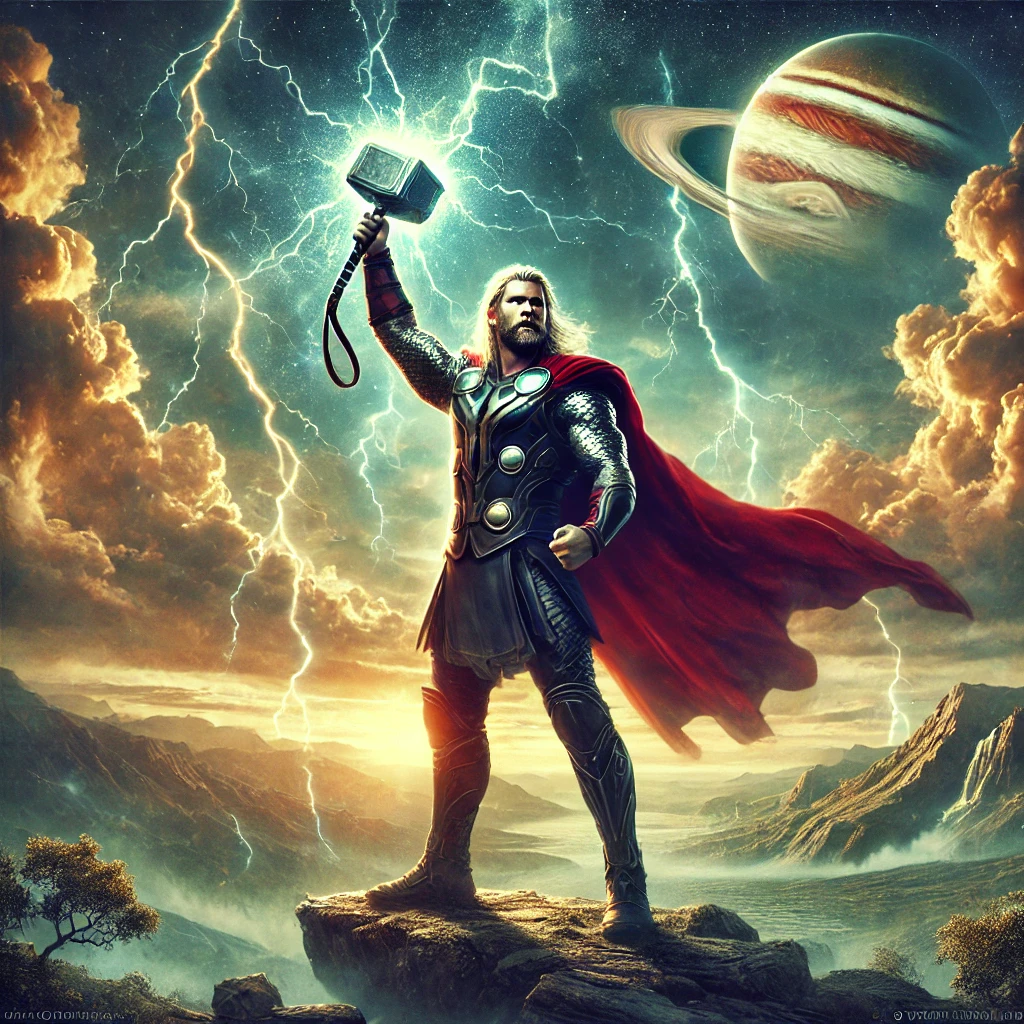
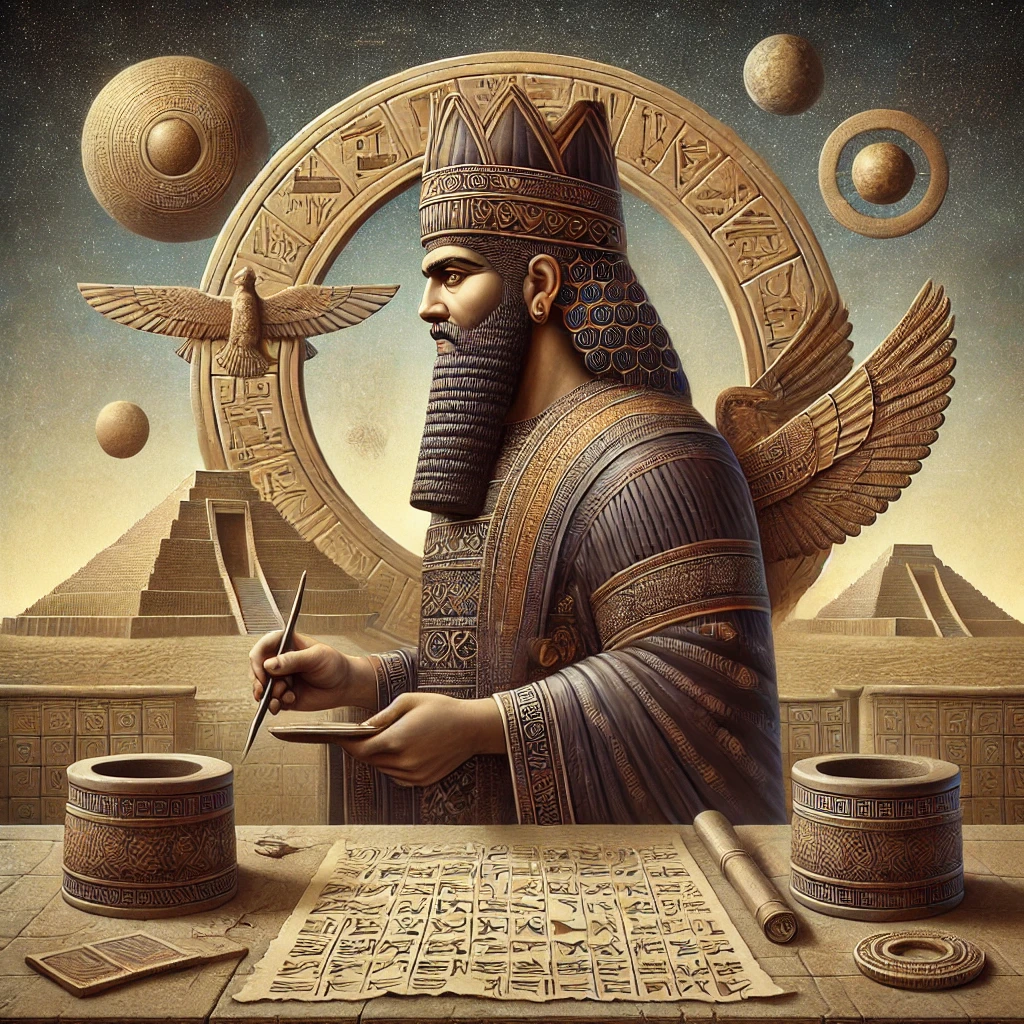
Day 16 of 2025 is a Thursday, from the Germanic tribes’ Thor’s Day. Thor is a thunder god similar to Jupiter and Zeus. The Babylonians associated Jupiter with their most powerful god, Marduk.
The Babylonian god Marduk, as imagined by ChatGPT.The Roman god Jupiter, as imagined by ChatGPTThe Greek god Zeus, as imagined by ChatGPTThe Germanic tribe god Thor, as imagined by ChatGPT
The research I have done these last few days has connected me culturally with the past. I don’t remember learning much history as a child. I was fascinated by numbers and hated memorizing the British kings and various dates of wars. Now, I have a greater appreciation for this knowledge. Here is a table summarizing the early Mesopotamian peoples and their deities tied to celestial bodies. The celestial bodies are in Chaldean order based on their apparent speed from slowest to fastest. This ordering, and the assignment of these objects to hours in the day, gave rise to the Babylonian calculation of a “ruling body”. Since 24 hours in a day, and 24/7 having a remainder of 3, then the days of the week get named for the bodies Saturn, Sun, Moon, Mars, Mercury, Jupiter, Venus. Notice this pattern of “skip two” in the Chaldean order below.
Deities of ancient Mesopotamians
Peoples/City-States
Saturn
Jupiter
Mars
Sun
Venus
Mercury
Moon
Sumerians
Ninurta
Enlil
Nergal
Utu
Inanna
Ningishzida
Nanna
Akkadians/ Babylonians
Ninurta
Marduk
Nergal
Shamash
Ishtar
Nabû
Sin
Ugaritic
El
Baal (Hadad)
Anat (Resheph)
Shapash
Astarte
Kothar-wa-Khasis
Yarikh
Phoenicians
Baal Hammon
Baal Shamin
Resheph
Shapash
Astarte
Eshmun
Yarikh
Parthians
Zurvan
Mithra
Verethragna
Hvare-khshaeta
Anahita
Tishtrya
Mah (Maonghah)
It quite amazing to me that ancient Mesopotamian astrologers had such an influence on the calendar days of the week that the world uses today. That is quite some powerful universe surfing that someone did way back then.
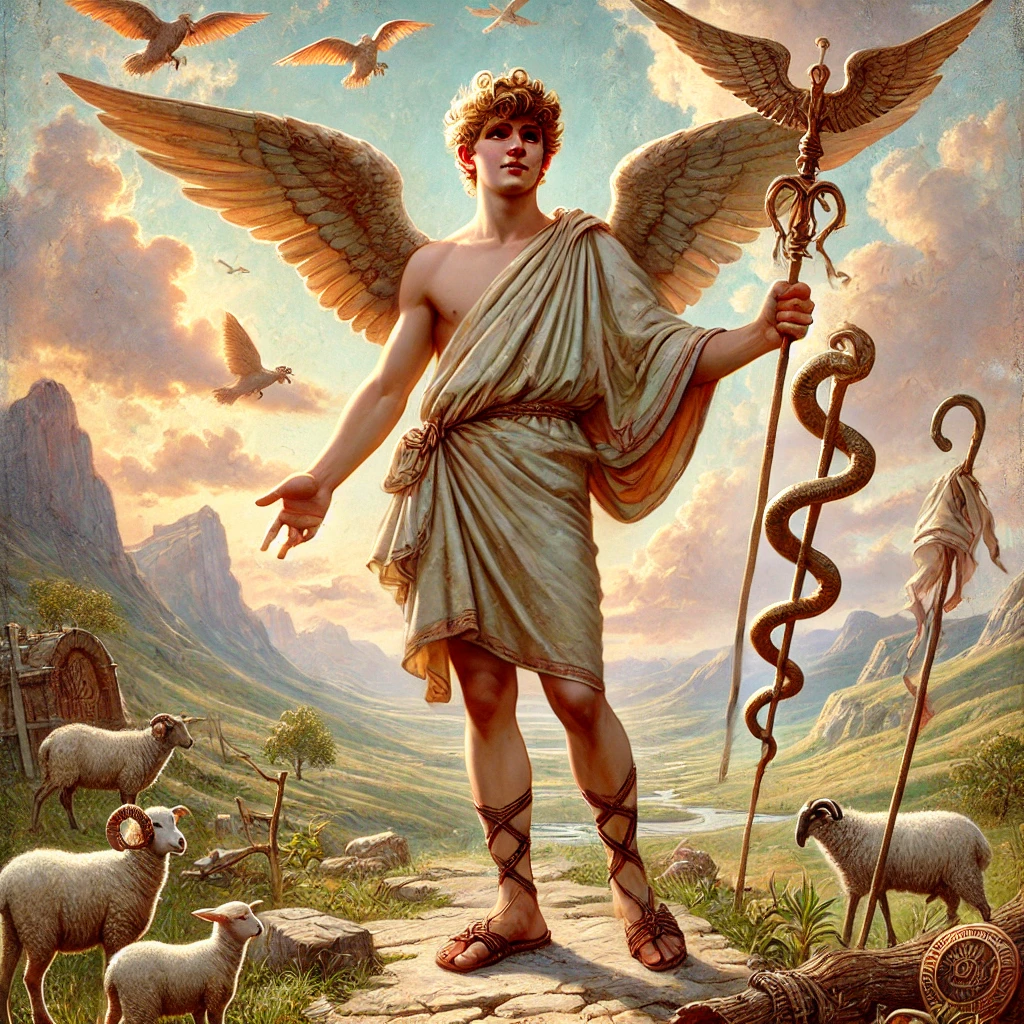
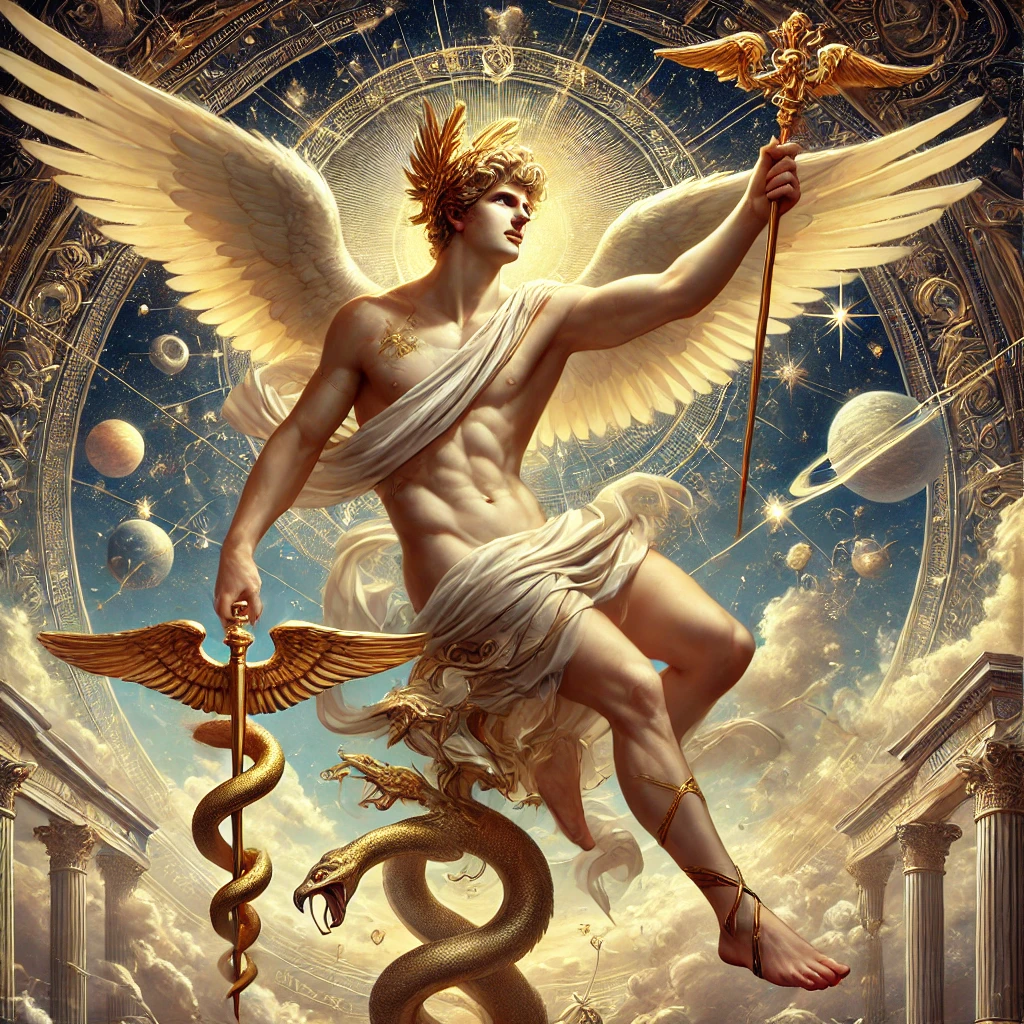
Day 15 of 2025 is a Wednesday, from Woden’s Day in Old English (Wōdnesdæg). The Romance languages are closer to the Latin Dies Mercurii (Mercredi, Mercoledì, Miércoles). The Romans adopted much of Greek mythology and their god Mercury was inspired by the Greek god Hermes. In Greek tradition around the year 975 BCE, Wednesday was called Heméra Hermú (Ημέρα Ερμή), meaning Day of Hermes. The Greeks adopted the seven-day week and linked their own gods to the planetary system inherited from the Babylonians. In the year 1975 BCE, the deity associated with the planet Mercury by the Babylonians was called Nabu. Nabu was the god of writing, wisdom, and scribes. Below are ChatGPT-generated images of these different deities.
Proto-Nabu (4975 BCE): Draped in simple woven garments, Proto-Nabu reflects early Mesopotamian reverence for stars, crops, and tools of understanding, bridging the natural and mystical worlds.Nabu (1975 BCE): Nabu, the Babylonian god of wisdom and writing, holds his stylus and clay tablet, standing before a grand ziggurat that symbolizes the seat of divine knowledge.Hermes (975 BCE): Hermes from Greek mythology during the Archaic period. He is shown as youthful and energetic, wearing a simple chiton, with early representations of his winged sandals and a caduceus, surrounded by symbols of trade and travel in a pastoral setting.Mercury (25 CE): Mercury, the swift messenger of the gods, strides with winged sandals and caduceus in hand, a symbol of speed and eloquence in classical mythology.Wodin (975 CE): Odin, the Germanic god of wisdom, war, and poetry, seated on his high throne, Hlidskjalf, with his ravens Huginn and Muninn, surrounded by the mystical Scandinavian landscape and the towering World Tree, Yggdrasil.
Seven thousand years ago, the Sumerians inhabited the southern Mesopotamia region. The year was 4975 BCE. Around this time, the Eridu Temple was celebrating its 500 year anniversary as the birthplace of organized religion in Mesopotamia. The temple was primarily dedicated to the deity Enki, the god of water, wisdom, and creation. The temple was carefully oriented along the cardinal directions, with the main entrance facing east towards the rising Sun.
The people who lived here during this time before the Sumerians are known as the Ubaid peoples. The Ubaid Period (c. 6500-4000 BCE) represents the formative stage of Mesopotamian civilization. These people developed irrigation agriculture, built temple structures, and practiced religious rituals. The created utilitarian, handcrafted pottery with geometric patterns printed in dark brown or black on light greenish or buff clay. Their pottery style was traded over a large area. They left no written records. Their villages were composed of rectangular, multi-room houses built from mudbrick. The houses had flat roofs and central courtyards. They used clay tokens shaped to represent various commodities. They made distinctive anthropomorphic figurines, usually female, with exaggerated features like elongated heads or prominent hips.
It is unclear whether or not the Ubaid people used a base-60 counting system. Their lack of writing makes it difficult to determine whether they or the Sumerians developed a base-60 system. With their clay tokens it seems quite obvious that they counted. As an agricultural community, knowing when to plant and harvest would be important. So, counting the number of moon cycles in a solar cycle would be known. There are 12 full moon cycles in one year. 12 is an important number in ancient and current cultures. Finger counting with three segments per finger and four fingers leads naturally to 12. Using 0, 1, 2, 3, or 4 fingers of the other hand leads naturally to 5 times 12 equals 60. It seems very likely to me that the Ubaid people had at least a base 12 system, if not a base 12*5 system. This would lead naturally to dividing the day into 12 “hours”.
Today is Tuesday. Tuesday is named after the Roman god Mars, the god of war, which parallels the Babylonian god Nergal, also a deity of war, destruction, and the underworld. In many Romance languages, the name retains the link to Mars (e.g. Martes in Spanish, Mardi in French, and Martedi in Italian). The English name Tuesday is associated with the Norse god Tyr, the god of courage, strength, combat and justice. Mars’ fiery red appearance has long associated it with war, action, and energy.
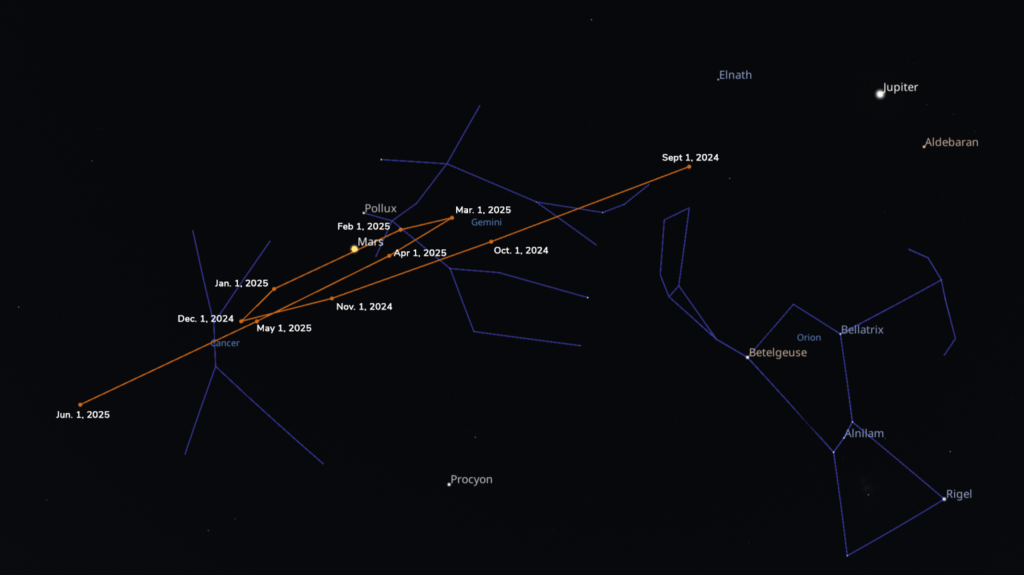
Tomorrow, January 15, 2025, Mars will be at opposition! As a universe surfer, I note this synchronicity of me blogging about Mars on this day. Last night when I was viewing the full moon, Mars was passing behind the moon and you could see Mars at the edge of the moon. During opposition, Mars is at its closest point to Earth for the year. Earth will be directly between Mars and the Sun. The retrograde (westward) motion of Mars, which has been going on for the last month, will peak tomorrow and continue for another month until Mars exits retrograde and begins moving eastward again.
This is a simulated picture of what it looked like last night when Mars was near the Moon (Image credit: NASA.gov)Mars retrograde motion Sept 2024 to June 2025 (Ref: NASA 2024 Stellarium Maps of Mars Retrograde)
Synchronicities are probabilistically unexpected and also meaningful to the one experiencing the synchronicity. Checking ChatGPT now, the next time Mars will be at opposition after January 15, 2025, will be on March 5, 2027, at approximately 10:19 PM (UTC). Oh interesting, 10:19 is a meaningful number from my past and so this is also adding to my feeling of synchronicity. This is based on the average 779.93-day synodic period between successive oppositions.
The Babylonians were the first to systematically track the synodic period of Mars (Salu, The Red Star). They recorded its oppositions and retrograde motion on cuneiform tablets (The Enuma Anu Enlil and Astronomical Diaries) as early as the 7th century BCE. I find it interesting that 780 is also quite a divisor heavy number that includes 60 as a divisor. The divisors of 780 are 1, 2, 3, 4, 5, 6, 10, 12, 13, 15, 20, 26, 30, 39, 52, 60, 65, 78, 130, 156, 195, 260, 390, and 780. Notable additions that are not divisors of 60 include the multiples of 13 (13, 26, 39, 52, 65, 78, 156, 195, 260, and 390). Removing divisors of 15 gives a smaller list (13, 26, 39, 52, 78, and 156). It’s amusing how the number 13, which I discussed yesterday as being unbalancing (2025 Day 13: Day of the Moon), has worked it’s way back in to balance through the Earth-Mars synodic period of 780 days.
Diving Deeper: The base-60 numbering system of the Babylonians is more precisely a combination of a base-6 and base-10 numbering system. The 360º circle is evidence for this, but the main evidence is how numbers were represented. Numbers 1 to 9 were represented by vertical wedge marks. Multiples of 10, 10 to 50, were represented by sideways wedge marks. Other numbers 11 to 59 were represented by a combination of vertical wedges and sideways wedges. The number 60 was represented by the same vertical wedge mark as the number 1, but shifted to the next positional value to the left.
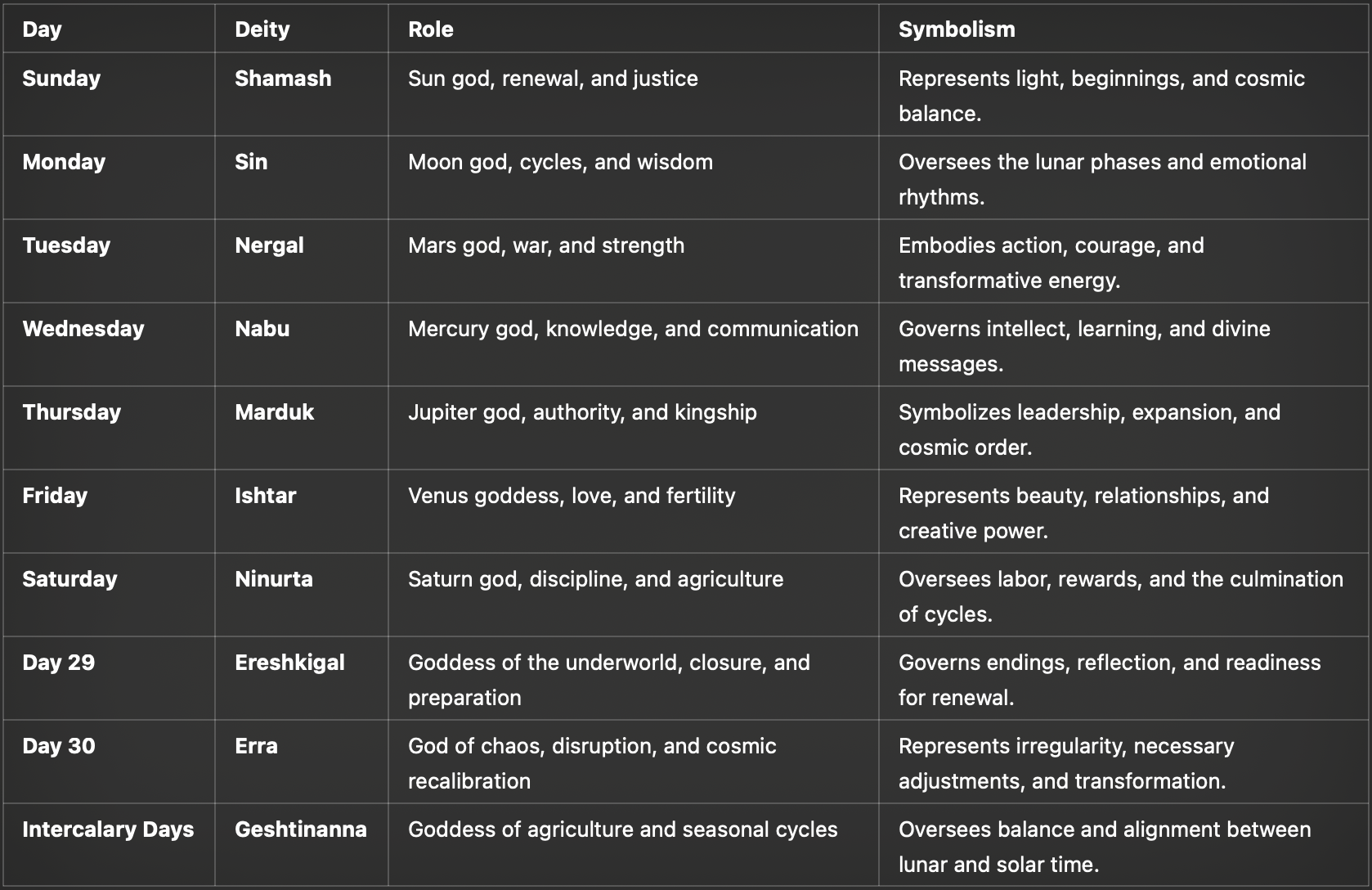
The next few days I will cover the remaining days of the week and their history of assignment from the ancient Babylonian time period. I created the following chart with the help of ChatGPT. I don’t have evidence of the 29th and 30th and intercalary days deities. I just assigned those myself based on the role of the deity. I am also assuming that the first (and 8th, etc.) day of the lunar cycle is always a Sunday. This is based on the idea that multiple of 7 days would be days of rest and reflection, and aligned with the Saturn god Ninurta.





 surfing the universe
