For the last week, I have been curious about the history of the 7-day week. This led me to a curiosity around the sexagesimal (base-60) number system developed by the Sumerians over five thousand years ago. The earliest evidence of counting is the clay tokens made in standardized shapes over seven thousand years ago. These shapes included spheres, cones, cylinders and discs. They seem to have been used for numerical abstraction and record-keeping.
In a sexagesimal (base-60) number system, one counts from 1 to 59, and then 60 is represented by the same symbol as 1, now with a weight of 60. Normally, the position of the symbol is used to determine the weight. In the Sumerian system, the rightmost position represented units 1-59, the next position represented multiples of 60 (60-3540). The third position represented multiples of 3600 (3600-212400). You can see how you can represent large numbers with only a few sexagesimal symbols. Fractions were also represented in a similar way by positional symbols to the right of the main unit. There was apparently no “decimal point” and context of usage was needed to distinguish between 60, 1, and 1/60th.
In the ancient Babylonian times, it was known that lunar cycle (of 29.53 days) and the solar cycle (of 365.25 days) would synchronize every 19 years (19 * 365.25 / 29.53 = 235.007), which equals very close to 235 lunar cycles (off by 0.007 lunar month, about 2 hrs or 1/12th of a full day). This 19-year cycle would need a single day adjustment only every 12 * 19 =228 years!
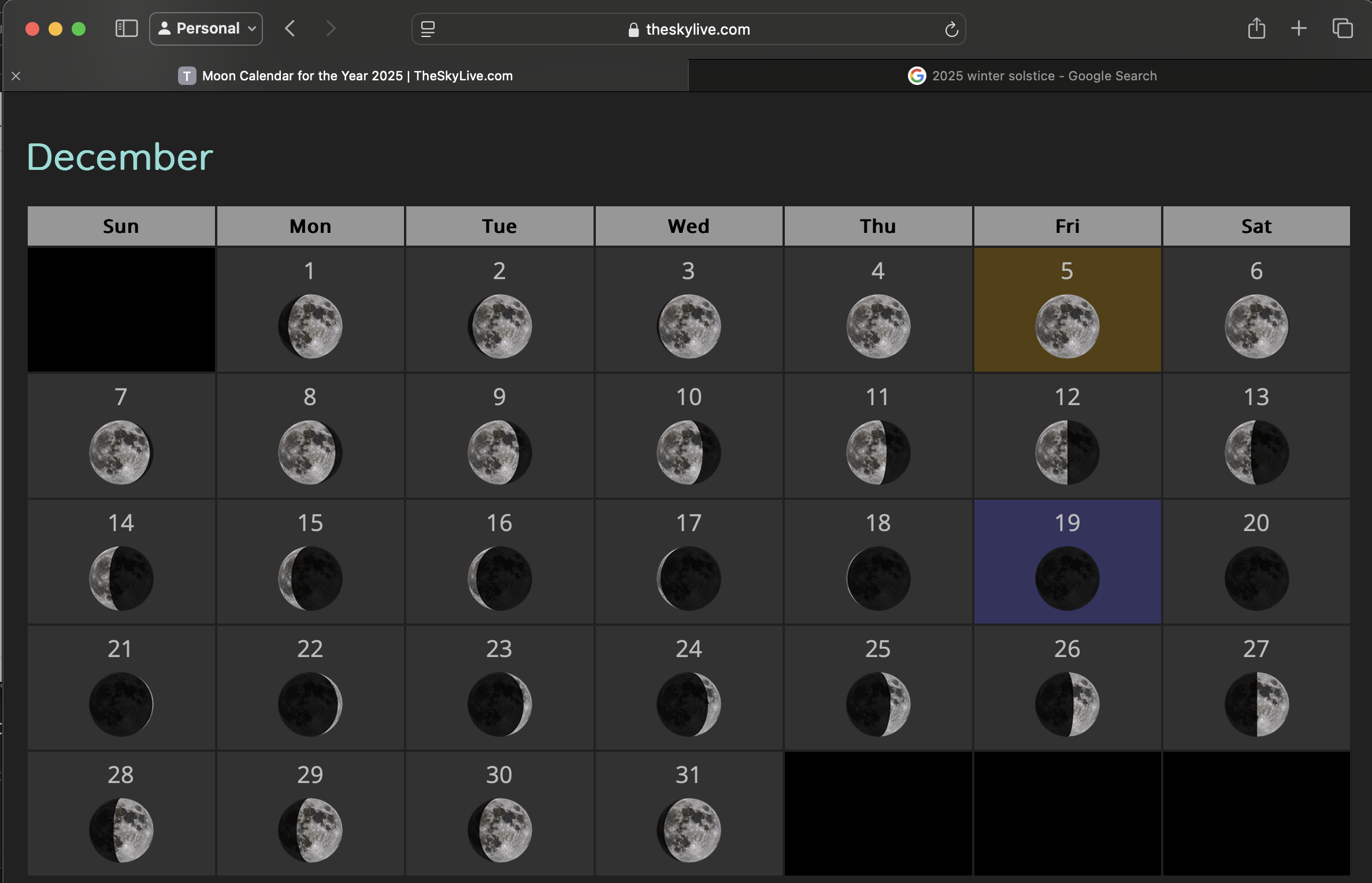
WOW! I have been researching lunar and solar cycles for hours. It’s now Monday and I am still finishing this blog. I have been trying to figure out when the next alignment of the lunar and solar cycles would be. As my alignment, I have been using the winter solstice and the beginning of the lunar cycle as the Babylonians calculated it. Well, this year is the year! The winter solstice will be on December 21, 2025 (9:02am CST). And, that evening after sunset will be the first crescent moon of the new moon cycle!
It’s now morning and the sun is rising again. I only wrote the title of this post last night. I was doing a bit of research on Sunday about the history of Sunday. When near midnight I read that Sunday has traditionally been a day of rest, I felt myself getting very sleepy. I decided to finish in the morning. Now I am reading that actually the 7th day is the day of rest, so I have to wait until Saturday to rest.
Day 12 of 2025 is a Sunday. How synchronistic in many ways. To learn the origin of Sunday, we have to travel back seven millennium to the time period of 2025-7000 =-4,975. Geographically, we need to focus on southern Mesopotamia. During this first millennial time period of 4975 BCE to 3976 BCE, the people of this area were moving from dispersed Neolithic settlements to more centralized villages. Irrigation was used to move water from the Tigris and Euphrates rivers. A reliable water supply allowed these villages to grow barley crops, dates, and keep livestock. Temples were constructed, with the earliest and most significant one being the temple of Eridu.
Aside: In Sumerian mythology, Eridu is the first city. It was created by the gods. It is associated with the god Enki (also known as Ea), the god of water, knowledge, mischief, crafts, and creation. The Eridu temple, known as the E-abzu, is dedicated to the god Enki. Archaeologists call this millennial period the Ubaid period, which continues to c. 4000 BCE.
There were no written calendars and cuneiform did not exist yet. Archaeologists have found clay tokens of different shapes. I have not seen any research that claims these tokens were used as money, but it only makes sense to me that they were used as a medium of exchange. Here are seven different types of tokens and how I imagine that they might have been used. I have also ordered them and given a representation I will explain later.
Cone – for barley and wheat, representing a cone of light, life, and earthly sustenance
Ovoid – for eggs and small animals, representing cycles, fertility and wisdom
Disc – for fish and cheese, representing conflict and nourishment from struggle
Cylinder – for rolled textiles and rugs, representing communication and trade
Gemstones, e.g. obsidian or lapis lazuli – for luxury items, representing wealth and authority
Spherical – for livestock, representing fertility, beauty and abundance
Triangle/Wedge – for land or labor, representing structure, balance, and discipline
The ancient Babylonians used one of the most advanced mathematical systems of their time. The sexagesimal (base-60) system is the foundation for our 360º circle, 60 minutes in an hour, 60 seconds in a minute, and 24 hours in a day. The number 60 was chosen because it is highly divisible (with divisors of 1, 2, 3, 4, 5, 6, 10, 12, 15, 20, 30, and 60). This makes it ideal for fractional measurements. It also makes it useful for dividing time, space and celestial cycles.
Notice how the divisors of 60 include all the integers up through six, but not seven. Seven is mathematically special in a base-60 numbering system. Additionally, the lunar cycle is about 29.5 days on average (it varies between 29.27 and 29.83 days). Day 1 of a lunar cycle would begin with the first crescent moon after the new moon. This would naturally lead to day 7, 14, 21, and 28 aligning very closely with four main phases of the moon: first quarter, full moon, last quarter, and dark moon. On these multiple of 7 days, certain activities were forbidden or restricted by the Babylonian priests. Old Mesopotamian texts refer to these four days of the lunar month as “ul ūma” (evil days). These days were considered both sacred and inauspicious. Therefore, to avoid angering the gods, or disturbing the cosmic order, certain activities were restricted. The reasoning was tied to the Moon’s transition points which were seen as powerful but unstable energy.
On these moon transition points, the priests advised the following:
Avoid making major decisions or judgments
Refrain from starting new ventures
Refrain from working or agricultural work
Avoid travel or expeditions
Practice sexual abstinence
Limit public appearances or displays of power
Practice self reflection and mindfulness
To counteract the inauspicious energies and to counterbalance the risks of acting on these sacred days, priests often prescribed rituals:
Sacrifices and offerings of animals, grains, or incense to appease the gods
Consult omens through liver readings, astrology, or other forms of divination
Undergo ritual cleansings (e.g. fasting, bathing in sacred water)
Align with divine will through seclusion, mediation, and prayer
Diving Deeper: The Enuma Anu Enlil is a collection of astronomical and astrological omens. It details the significance of lunar days and specifically mentions the multiple of seven days:
Day 7: A day of rest and worship
Day 14: A day of reflection and time of fullness – no war or harsh judgments
Day 21: A day of introspection and preparation
Day 28: A day of vulnerability and time of renewal – defer decisions and prioritize rituals
These multiple of seven days are actually tied to Saturday rather than Sunday. So, for Sunday we have:
Day 1: A day to start new initiatives and a time of renewal
Day 8: A day to build momentum and make progress in a measured way
Day 15: A day to celebrate accomplishments, avoid hubris, seek balance, and tap into your divinity
Day 22: A day to reflect, consolidate, and prepare for the end of the cycle
Update 2025-0118S-1034: I don’t know if I was inspired by my 5-year ago post when I blogged about this day. I have been checking these to get inspiration so it is very likely that I did. However, I don’t know remember doing so. It was a short post 5 years ago which I can just include here:
The number 12 is special to Earth, it’s Moon, and the Sun through the fact that the Moon revolves around the Earth 12 times during the time that the Earth revolves around the sun. There are 12 lunar cycles plus 11 or 12 days in a year. The Babylonians calendar defined a year to be 12 lunar months, each beginning with a new sunset crescent moon in the western sky. Twelve is found prominently in Judaism, Christianity, Islam, Buddhism, Hinduism, and Greek mythology.


 surfing the universe