
2025-0114T-0925 Austin, TX
Today is Tuesday. Tuesday is named after the Roman god Mars, the god of war, which parallels the Babylonian god Nergal, also a deity of war, destruction, and the underworld. In many Romance languages, the name retains the link to Mars (e.g. Martes in Spanish, Mardi in French, and Martedi in Italian). The English name Tuesday is associated with the Norse god Tyr, the god of courage, strength, combat and justice. Mars’ fiery red appearance has long associated it with war, action, and energy.
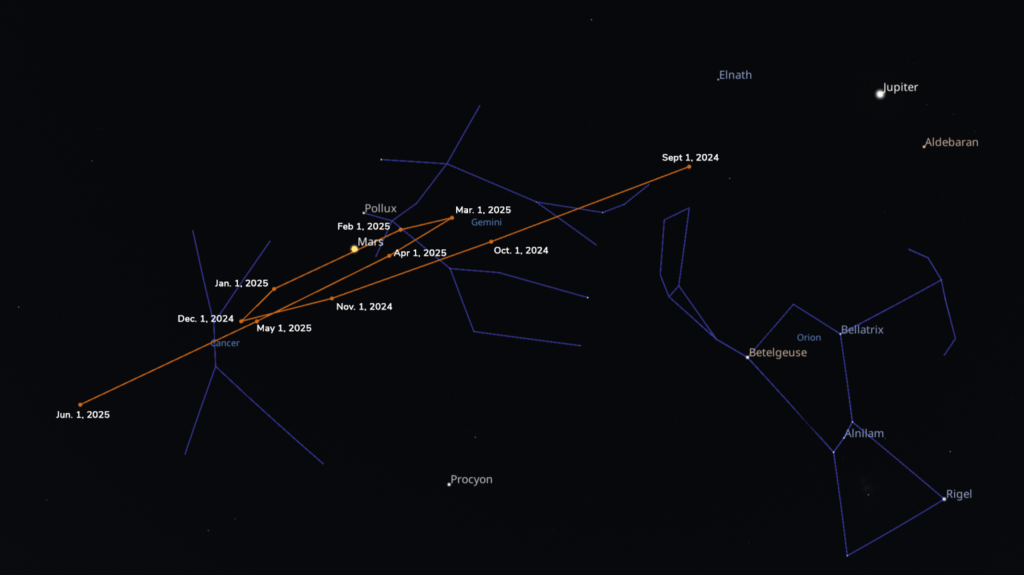
Tomorrow, January 15, 2025, Mars will be at opposition! As a universe surfer, I note this synchronicity of me blogging about Mars on this day. Last night when I was viewing the full moon, Mars was passing behind the moon and you could see Mars at the edge of the moon. During opposition, Mars is at its closest point to Earth for the year. Earth will be directly between Mars and the Sun. The retrograde (westward) motion of Mars, which has been going on for the last month, will peak tomorrow and continue for another month until Mars exits retrograde and begins moving eastward again.

Synchronicities are probabilistically unexpected and also meaningful to the one experiencing the synchronicity. Checking ChatGPT now, the next time Mars will be at opposition after January 15, 2025, will be on March 5, 2027, at approximately 10:19 PM (UTC). Oh interesting, 10:19 is a meaningful number from my past and so this is also adding to my feeling of synchronicity. This is based on the average 779.93-day synodic period between successive oppositions.
The Babylonians were the first to systematically track the synodic period of Mars (Salu, The Red Star). They recorded its oppositions and retrograde motion on cuneiform tablets (The Enuma Anu Enlil and Astronomical Diaries) as early as the 7th century BCE. I find it interesting that 780 is also quite a divisor heavy number that includes 60 as a divisor. The divisors of 780 are 1, 2, 3, 4, 5, 6, 10, 12, 13, 15, 20, 26, 30, 39, 52, 60, 65, 78, 130, 156, 195, 260, 390, and 780. Notable additions that are not divisors of 60 include the multiples of 13 (13, 26, 39, 52, 65, 78, 156, 195, 260, and 390). Removing divisors of 15 gives a smaller list (13, 26, 39, 52, 78, and 156). It’s amusing how the number 13, which I discussed yesterday as being unbalancing (2025 Day 13: Day of the Moon), has worked it’s way back in to balance through the Earth-Mars synodic period of 780 days.
Diving Deeper: The base-60 numbering system of the Babylonians is more precisely a combination of a base-6 and base-10 numbering system. The 360º circle is evidence for this, but the main evidence is how numbers were represented. Numbers 1 to 9 were represented by vertical wedge marks. Multiples of 10, 10 to 50, were represented by sideways wedge marks. Other numbers 11 to 59 were represented by a combination of vertical wedges and sideways wedges. The number 60 was represented by the same vertical wedge mark as the number 1, but shifted to the next positional value to the left.
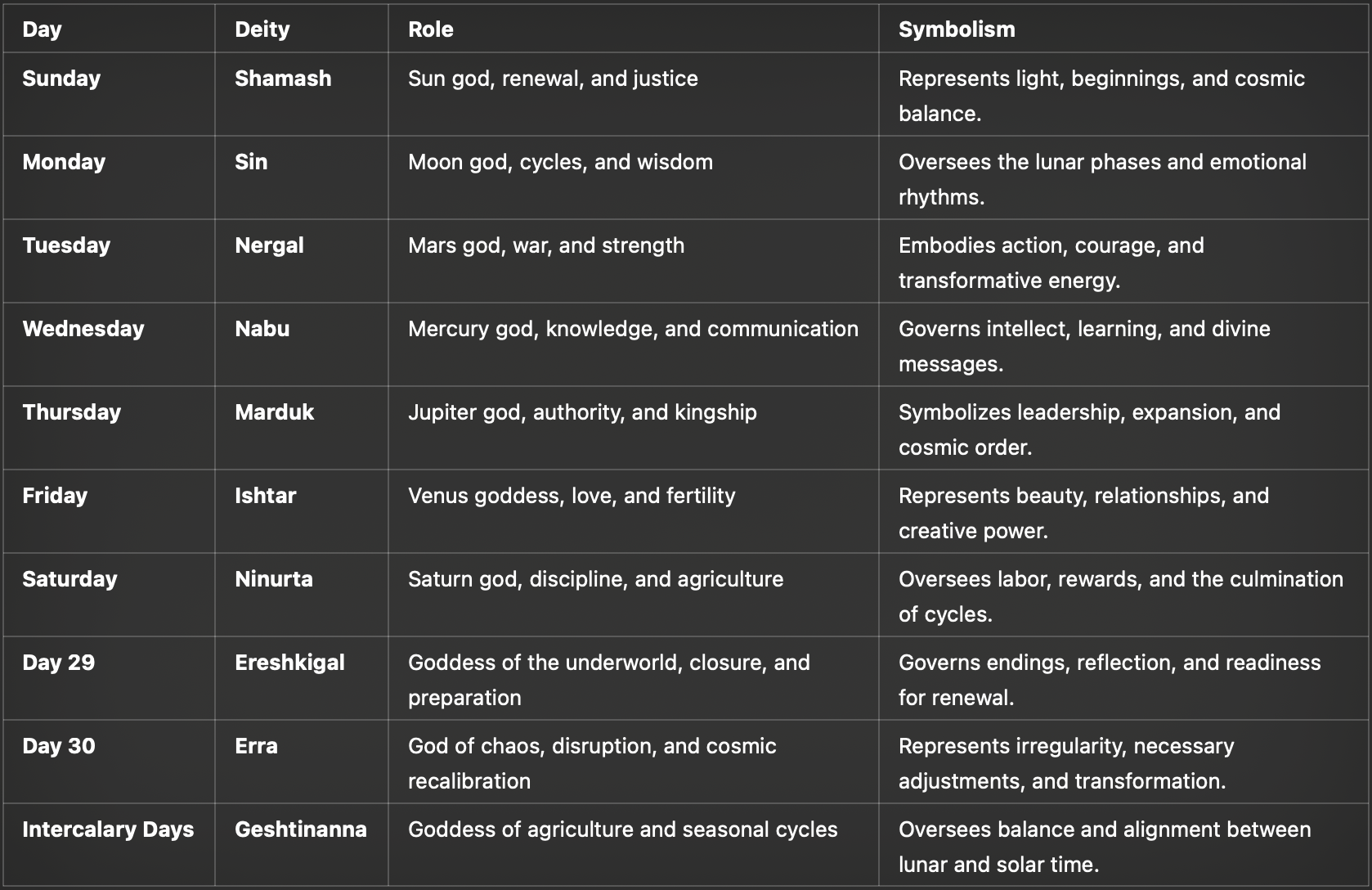
The next few days I will cover the remaining days of the week and their history of assignment from the ancient Babylonian time period. I created the following chart with the help of ChatGPT. I don’t have evidence of the 29th and 30th and intercalary days deities. I just assigned those myself based on the role of the deity. I am also assuming that the first (and 8th, etc.) day of the lunar cycle is always a Sunday. This is based on the idea that multiple of 7 days would be days of rest and reflection, and aligned with the Saturn god Ninurta.
Looking back five years: On this day five years ago I blogged about Buddhism: https://surfingtheuniverse.com/2020/01/15/2020-day-14-the-fourteen-precepts-of-engaged-buddhism/. These fourteen guidelines still resonate with me.
 surfing the universe
