2025 Day 14: Day of Mars

2025-0114T-0925 Austin, TX

Today is Tuesday. Tuesday is named after the Roman god Mars, the god of war, which parallels the Babylonian god Nergal, also a deity of war, destruction, and the underworld. In many Romance languages, the name retains the link to Mars (e.g. Martes in Spanish, Mardi in French, and Martedi in Italian). The English name Tuesday is associated with the Norse god Tyr, the god of courage, strength, combat and justice. Mars’ fiery red appearance has long associated it with war, action, and energy.

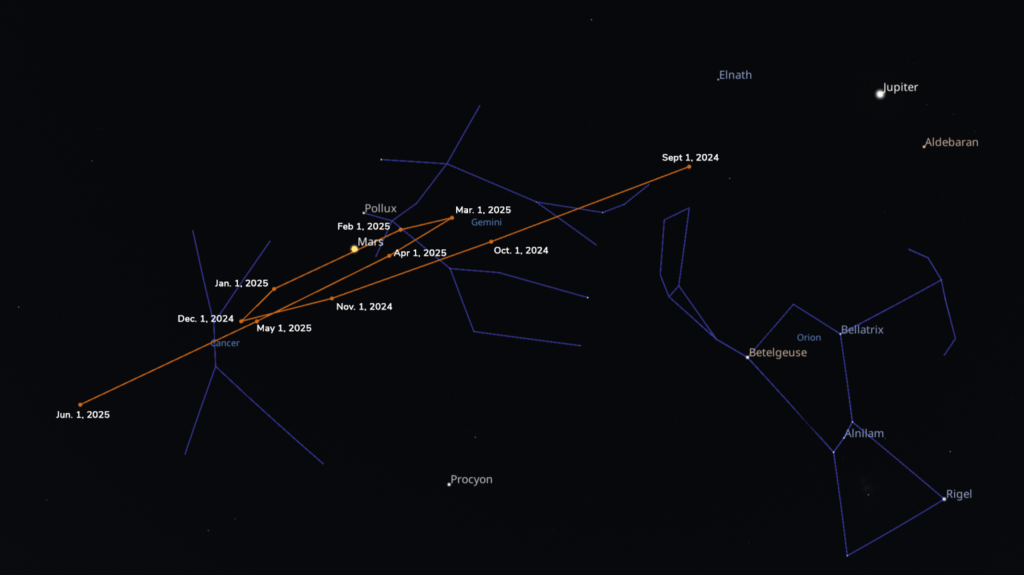
Tomorrow, January 15, 2025, Mars will be at opposition! As a universe surfer, I note this synchronicity of me blogging about Mars on this day. Last night when I was viewing the full moon, Mars was passing behind the moon and you could see Mars at the edge of the moon. During opposition, Mars is at its closest point to Earth for the year. Earth will be directly between Mars and the Sun. The retrograde (westward) motion of Mars, which has been going on for the last month, will peak tomorrow and continue for another month until Mars exits retrograde and begins moving eastward again.

This is a simulated picture of what it looked like last night when Mars was near the Moon (Image credit: NASA.gov)
Mars retrograde motion Sept 2024 to June 2025 (Ref: NASA 2024 Stellarium Maps of Mars Retrograde)

Synchronicities are probabilistically unexpected and also meaningful to the one experiencing the synchronicity. Checking ChatGPT now, the next time Mars will be at opposition after January 15, 2025, will be on March 5, 2027, at approximately 10:19 PM (UTC). Oh interesting, 10:19 is a meaningful number from my past and so this is also adding to my feeling of synchronicity. This is based on the average 779.93-day synodic period between successive oppositions.

The Babylonians were the first to systematically track the synodic period of Mars (Salu, The Red Star). They recorded its oppositions and retrograde motion on cuneiform tablets (The Enuma Anu Enlil and Astronomical Diaries) as early as the 7th century BCE. I find it interesting that 780 is also quite a divisor heavy number that includes 60 as a divisor. The divisors of 780 are 1, 2, 3, 4, 5, 6, 10, 12, 13, 15, 20, 26, 30, 39, 52, 60, 65, 78, 130, 156, 195, 260, 390, and 780. Notable additions that are not divisors of 60 include the multiples of 13 (13, 26, 39, 52, 65, 78, 156, 195, 260, and 390). Removing divisors of 15 gives a smaller list (13, 26, 39, 52, 78, and 156). It’s amusing how the number 13, which I discussed yesterday as being unbalancing (2025 Day 13: Day of the Moon), has worked it’s way back in to balance through the Earth-Mars synodic period of 780 days.

Diving Deeper: The base-60 numbering system of the Babylonians is more precisely a combination of a base-6 and base-10 numbering system. The 360º circle is evidence for this, but the main evidence is how numbers were represented. Numbers 1 to 9 were represented by vertical wedge marks. Multiples of 10, 10 to 50, were represented by sideways wedge marks. Other numbers 11 to 59 were represented by a combination of vertical wedges and sideways wedges. The number 60 was represented by the same vertical wedge mark as the number 1, but shifted to the next positional value to the left.

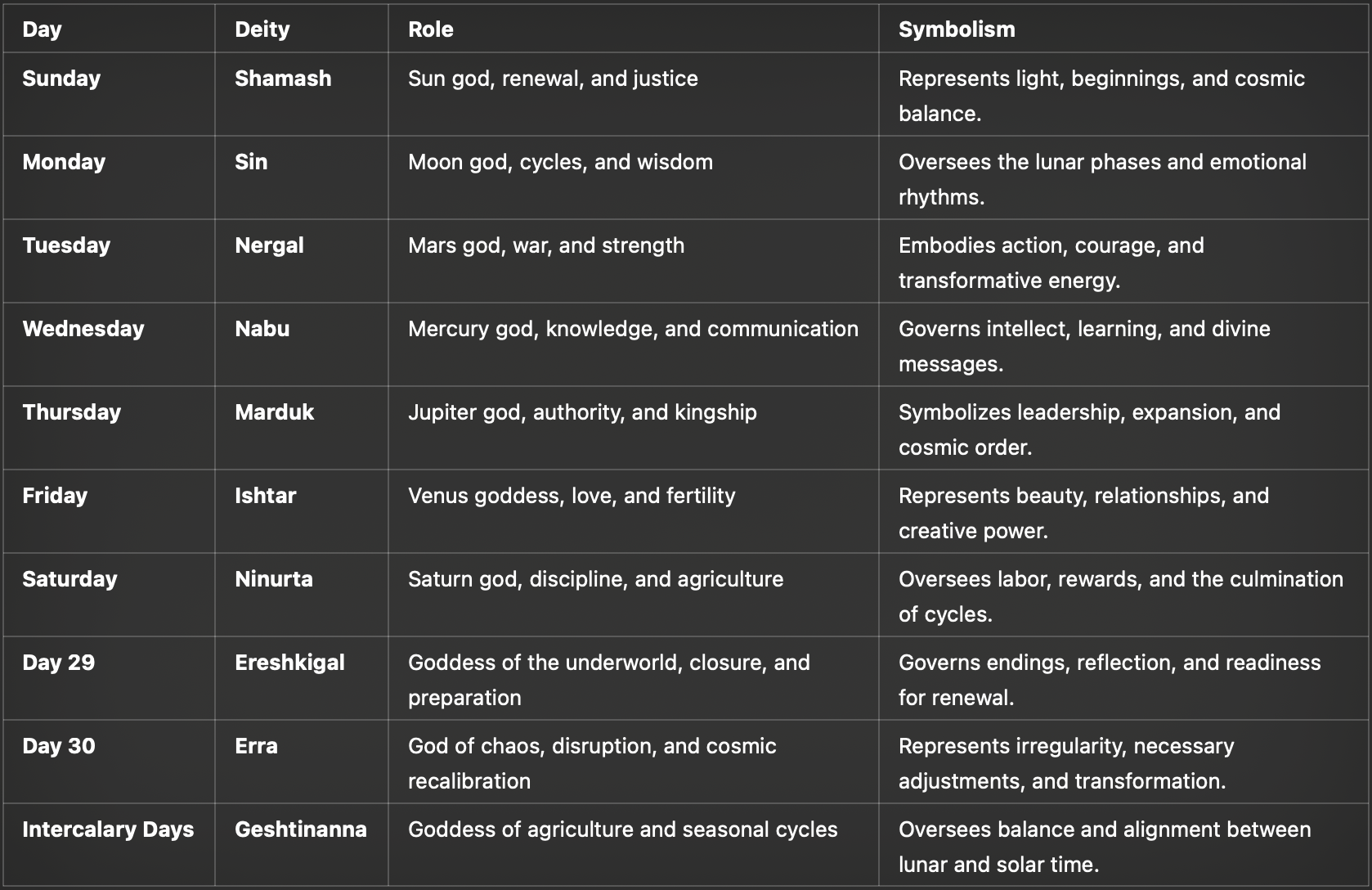
The next few days I will cover the remaining days of the week and their history of assignment from the ancient Babylonian time period. I created the following chart with the help of ChatGPT. I don’t have evidence of the 29th and 30th and intercalary days deities. I just assigned those myself based on the role of the deity. I am also assuming that the first (and 8th, etc.) day of the lunar cycle is always a Sunday. This is based on the idea that multiple of 7 days would be days of rest and reflection, and aligned with the Saturn god Ninurta.
Looking back five years: On this day five years ago I blogged about Buddhism: https://surfingtheuniverse.com/2020/01/15/2020-day-14-the-fourteen-precepts-of-engaged-buddhism/. These fourteen guidelines still resonate with me.


2025 Day 13: Day of the Moon

2025-0113M-2048 Austin, TX

Day 13 of 2025 is a Monday – day of the Moon. I’m actually writing this on Day 14, because it’s after midnight. That’s synchronistic because it’s a full moon now, which roughly marks Day 14 of the lunar cycle. Before writing, the full moon would be a multiple of 7 day and would be a day of rest and inner reflection. There would be no war. No harsh judgments.

But this blog is for Day 13. Like the number 7 of the ancient Babylonian times, the number 13 has some superstition surrounding it. The numbers 6 and 12 are considered complete. 7 and 13 disrupt the harmony of 6 and 12. They both represent excess, irregularity, transition, imbalance, and uncertainty. Many ancient cultures associated these numbers with misfortune. Divisibility of numbers was associated with harmony. Prime numbers like 7 and 13 have no divisibility except by 1 and itself. There are 13 full moons in a year which disrupts the natural alignment of the lunar year with the solar year. Today is Day 13 of 2025 and also a full moon.

The year 2025 is highly divisible with the divisors: 1, 3, 5, 9, 15, 25, 27, 45, 75, 81, 135, 225, 405, 675, and 2025. Last year 2024 had the divisors: 1, 2, 4, 8, 11, 22, 23, 44, 46, 88, 92, 184, 253, 506, 1012, and 2024. In 23 years when it is NYE before the year 2048, AI robots and such will be having a celebration like it’s 1999. Excluding 1, the divisors of 2048 are all multiples of 2: 1, 2, 4, 8, 16, 32, 64, 128, 256, 512, 1024, and 2048. So in computer binary numbers, the year will be 100000000000. This is  2^{11}, a single bit set at the 12th position (starting from the right). Ahhh … completion.

Diving Deeper: Mondays are synonymous with Days 2, 9, 16, and 23 and were transitional days in the lunar cycle. While not as prominently mentioned as the quarter phases, they had significance as moments of adjustment and preparation:

Day 2: Early waxing crescent, symbolizing growth and refinement of new beginnings.

Day 9: Momentum toward the first quarter, a time for strengthening and evaluating progress.

Day 16: Waning after the Full Moon, focusing on balance and stability.

Day 23: Waning crescent nearing the last quarter, symbolizing preparation for endings and consolidation.

2025 Day 12: Day of the Sun

2025-0112u-2345 Austin, TX

It’s now morning and the sun is rising again. I only wrote the title of this post last night. I was doing a bit of research on Sunday about the history of Sunday. When near midnight I read that Sunday has traditionally been a day of rest, I felt myself getting very sleepy. I decided to finish in the morning. Now I am reading that actually the 7th day is the day of rest, so I have to wait until Saturday to rest.

Day 12 of 2025 is a Sunday. How synchronistic in many ways. To learn the origin of Sunday, we have to travel back seven millennium to the time period of 2025-7000 =-4,975. Geographically, we need to focus on southern Mesopotamia. During this first millennial time period of 4975 BCE to 3976 BCE, the people of this area were moving from dispersed Neolithic settlements to more centralized villages. Irrigation was used to move water from the Tigris and Euphrates rivers. A reliable water supply allowed these villages to grow barley crops, dates, and keep livestock. Temples were constructed, with the earliest and most significant one being the temple of Eridu.

Aside: In Sumerian mythology, Eridu is the first city. It was created by the gods. It is associated with the god Enki (also known as Ea), the god of water, knowledge, mischief, crafts, and creation. The Eridu temple, known as the E-abzu, is dedicated to the god Enki. Archaeologists call this millennial period the Ubaid period, which continues to c. 4000 BCE.

There were no written calendars and cuneiform did not exist yet. Archaeologists have found clay tokens of different shapes. I have not seen any research that claims these tokens were used as money, but it only makes sense to me that they were used as a medium of exchange. Here are seven different types of tokens and how I imagine that they might have been used. I have also ordered them and given a representation I will explain later.

  1. Cone – for barley and wheat, representing a cone of light, life, and earthly sustenance
  2. Ovoid – for eggs and small animals, representing cycles, fertility and wisdom
  3. Disc – for fish and cheese, representing conflict and nourishment from struggle
  4. Cylinder – for rolled textiles and rugs, representing communication and trade
  5. Gemstones, e.g. obsidian or lapis lazuli – for luxury items, representing wealth and authority
  6. Spherical – for livestock, representing fertility, beauty and abundance
  7. Triangle/Wedge – for land or labor, representing structure, balance, and discipline

The ancient Babylonians used one of the most advanced mathematical systems of their time. The sexagesimal (base-60) system is the foundation for our 360º circle, 60 minutes in an hour, 60 seconds in a minute, and 24 hours in a day. The number 60 was chosen because it is highly divisible (with divisors of 1, 2, 3, 4, 5, 6, 10, 12, 15, 20, 30, and 60). This makes it ideal for fractional measurements. It also makes it useful for dividing time, space and celestial cycles.

Notice how the divisors of 60 include all the integers up through six, but not seven. Seven is mathematically special in a base-60 numbering system. Additionally, the lunar cycle is about 29.5 days on average (it varies between 29.27 and 29.83 days). Day 1 of a lunar cycle would begin with the first crescent moon after the new moon. This would naturally lead to day 7, 14, 21, and 28 aligning very closely with four main phases of the moon: first quarter, full moon, last quarter, and dark moon. On these multiple of 7 days, certain activities were forbidden or restricted by the Babylonian priests. Old Mesopotamian texts refer to these four days of the lunar month as “ul ūma” (evil days). These days were considered both sacred and inauspicious. Therefore, to avoid angering the gods, or disturbing the cosmic order, certain activities were restricted. The reasoning was tied to the Moon’s transition points which were seen as powerful but unstable energy.

On these moon transition points, the priests advised the following:

  1. Avoid making major decisions or judgments
  2. Refrain from starting new ventures
  3. Refrain from working or agricultural work
  4. Avoid travel or expeditions
  5. Practice sexual abstinence
  6. Limit public appearances or displays of power
  7. Practice self reflection and mindfulness

To counteract the inauspicious energies and to counterbalance the risks of acting on these sacred days, priests often prescribed rituals:

  1. Sacrifices and offerings of animals, grains, or incense to appease the gods
  2. Consult omens through liver readings, astrology, or other forms of divination
  3. Undergo ritual cleansings (e.g. fasting, bathing in sacred water)
  4. Align with divine will through seclusion, mediation, and prayer

Diving Deeper: The Enuma Anu Enlil is a collection of astronomical and astrological omens. It details the significance of lunar days and specifically mentions the multiple of seven days:

  1. Day 7: A day of rest and worship
  2. Day 14: A day of reflection and time of fullness – no war or harsh judgments
  3. Day 21: A day of introspection and preparation
  4. Day 28: A day of vulnerability and time of renewal – defer decisions and prioritize rituals

These multiple of seven days are actually tied to Saturday rather than Sunday. So, for Sunday we have:

  1. Day 1: A day to start new initiatives and a time of renewal
  2. Day 8: A day to build momentum and make progress in a measured way
  3. Day 15: A day to celebrate accomplishments, avoid hubris, seek balance, and tap into your divinity
  4. Day 22: A day to reflect, consolidate, and prepare for the end of the cycle

Update 2025-0118S-1034: I don’t know if I was inspired by my 5-year ago post when I blogged about this day. I have been checking these to get inspiration so it is very likely that I did. However, I don’t know remember doing so. It was a short post 5 years ago which I can just include here:

The number 12 is special to Earth, it’s Moon, and the Sun through the fact that the Moon revolves around the Earth 12 times during the time that the Earth revolves around the sun. There are 12 lunar cycles plus 11 or 12 days in a year. The Babylonians calendar defined a year to be 12 lunar months, each beginning with a new sunset crescent moon in the western sky. Twelve is found prominently in Judaism, Christianity, Islam, Buddhism, Hinduism, and Greek mythology.

2025 Day 3: Happy Birthday Anthony

2025-0103F-0707 Austin, TX

My then wife awoke a little after midnight. “I think it’s time”, she said. We timed the contractions and it was time to go to the hospital. I remember running a red light to get there. The rest is a blur until Anthony was born around 7am. I remember an old doctor coming in and checking on Anthony. He placed his thumbs on the soles of Anthony’s feet. Anthony’s toes curled around the doctor’s thumb. I exclaimed “Oh, that reflex must be from when we were monkeys and swung from trees.” The doctor looked at me confused and said something like “well, if you believe that fiction.” Since this story is burned in my memory, I was obviously shocked by a doctor not believing in evolution.

Yesterday, I saw a puppy sticking out its tongue. I was reminded of how very similar humans are to the other animal species. All life forms known to humans share a common genetic code origin which is highly conserved. This fact has always fascinated me since I learned it. In the winter of 2022, I started blogging on all the amino acids, beginning with A is for Alaline. An interesting thought experiment is to imagine that a probe finds life on asteroid, or even some frozen RNA/DNA fragments. How would our view of our origins change based on this discovery and analysis of the found RNA/DNA? What if it obviously matches our genetic code and appears from Earth? What if it obviously doesn’t? What if it doesn’t, but shows a common heritage?

In pondering these questions myself, I arrive at a creation story. Around 14 billion years ago our visible universe was reborn from whatever ancestor universe came before it. A few billion years later, our Milky Way galaxy was similarly reborn. Soon after, one of the solar systems in our galaxy began evolving life. The origin of this life occurred either in that solar system or another one that interfered with it. That solar system eventually died in a supernova or similar event. Hardy microbes survived in icy rocky asteroids that eventually found their way to our solar system as it formed. Initially in the Kuiper Belt, at least one of these asteroids crashed into Earth around 4 billion years ago. The rest is evolutionary history. Life is both very precious and very abundant in the multiverse. Creation is a recurring theme.

When I read my blog post from five years ago, I am reminded that I still struggle with replacing consumption with creation. I also failed in my 2020 intention of only checking my stock portfolio monthly. I still own AAPL, AMD, IBM, and WT. I sold SFM around $80 as it skyrocketed from $15 to $150 over the last few years. I also sold DS and NOK and bought EB, INTC, PYPL, and YELP.

Full Moon on Mar 18th, 2019 – a day after I reconnected with Anthony in downtown Austin